
Do Restaurant Loyalty Programs Work? | The Data


Quick Answer: Yes, but only when it’s built on real transaction data, and most restaurant loyalty programmes aren’t. Loyalty members made up 39% of all restaurant visits in 2024, roughly double their share in 2019, and loyalty members visit their enrolled restaurant brands at about twice the rate of non-members. The failure mode isn’t the concept; it’s the execution. Two-thirds of loyalty members belong to two or more competing programmes at once, and 35% cite confusing points and expiring rewards as their single biggest frustration. A programme tied to your actual ordering data and redeemable without friction works. A stamp card that nobody tracks usually doesn’t.
Half of restaurant owners running a loyalty programme couldn’t tell you whether it changed a single guest’s behaviour this month. They can report how many stamps were punched or how many points were issued, but not whether those guests would have come back anyway. That gap between activity and evidence is why the question keeps getting asked.
The honest answer sits in the middle: loyalty programmes work, and the data behind that claim is now specific enough to act on. But the same research that proves the upside also explains, in detail, why most restaurants running one never see it.
What the Data Actually Says About Loyalty and Repeat Visits
Restaurant loyalty membership grew from a niche retention tactic into the dominant source of traffic faster than most operators realised. Circana’s research on restaurant visit patterns found that loyalty members accounted for 39% of all restaurant visits in 2024, up from roughly half that share in 2019. At leading quick-service chains, that figure climbs past 50%.
The behavioural gap is the more useful number. Loyalty members make 22% more restaurant visits per year than non-members overall, and specifically at the brands they’ve enrolled with, they visit at roughly twice the rate of non-members: 8% of their total restaurant visits go to that one enrolled brand, against 4% for a non-member eating at the same restaurant occasionally.
That’s not proof that loyalty programmes create more hungry customers. Both groups visit around 20 different restaurant chains a year, so enrolling doesn’t make anyone eat out more often overall. What it does is redirect an existing visit toward you instead of a competitor, which is a smaller claim than most loyalty vendors make, and a far more believable one.
Why Most Restaurant Loyalty Programmes Quietly Fail
The same body of research that proves loyalty works also documents, in specific terms, why most programmes underdeliver on it.
The first problem is structural. Two-thirds of loyalty members belong to two or more programmes at the same time, which means a points card alone rarely buys real exclusivity; it buys a spot in a wallet full of other restaurants’ cards, competing for the same visit. A generic percentage-off punch card doesn’t change that calculation.
The second problem is friction. Industry research on loyalty member complaints found that 35% of members name complicated point accumulation and expiring rewards as their biggest source of frustration with restaurant programmes. If a guest has to check a separate app to see whether a reward is about to expire, most won’t bother, and the programme quietly becomes background noise rather than a reason to choose you.
The third problem is disconnected data. When a restaurant’s point-of-sale, online ordering, and loyalty tracking live in three separate systems, the programme can only send generic, calendar-based offers, a birthday discount, a monthly blast, rather than a message triggered by what a specific guest actually did. Guests notice the difference between an offer that reflects their order history and one that clearly didn’t.
None of that means loyalty programmes don’t work. It means most of them are built on infrastructure that can’t do the one thing that makes loyalty data valuable: connect a reward to the specific guest behaviour that earned it.
The 30-Day Window Most Restaurants Never Watch
If there’s one figure from recent industry research worth building a whole programme around, it’s this one: the 30 days following a guest’s first reward redemption decide whether a loyalty programme sticks. Guests who are re-engaged with a relevant, timely follow-up in that window increase their visit frequency by around 38%. Guests who aren’t simply flatline, and most never redeem a second reward.
Most restaurants miss this window entirely because their loyalty programme runs on a monthly newsletter schedule rather than a trigger tied to guest behaviour. By the time the next generic campaign goes out, the guest who redeemed their first reward three weeks ago has already decided the programme isn’t worth checking.
A related benchmark points at the same pattern from a different angle: guests who reach a fourth visit within a defined period return at a dramatically higher rate afterwards than guests who never get there. The fourth visit, not the first, is where habit actually forms, which means the goal of a new loyalty programme in its first 90 days isn’t maximising signups. It’s getting as many new members as possible to that fourth visit before they lapse.
What a Loyalty Programme That Actually Works Looks Like in Switzerland
Most loyalty advice assumes a dedicated app, a large in-house marketing team, or a chain’s worth of transaction volume, none of which describes an independent restaurant in Zurich or Lausanne running loyalty alongside everything else.
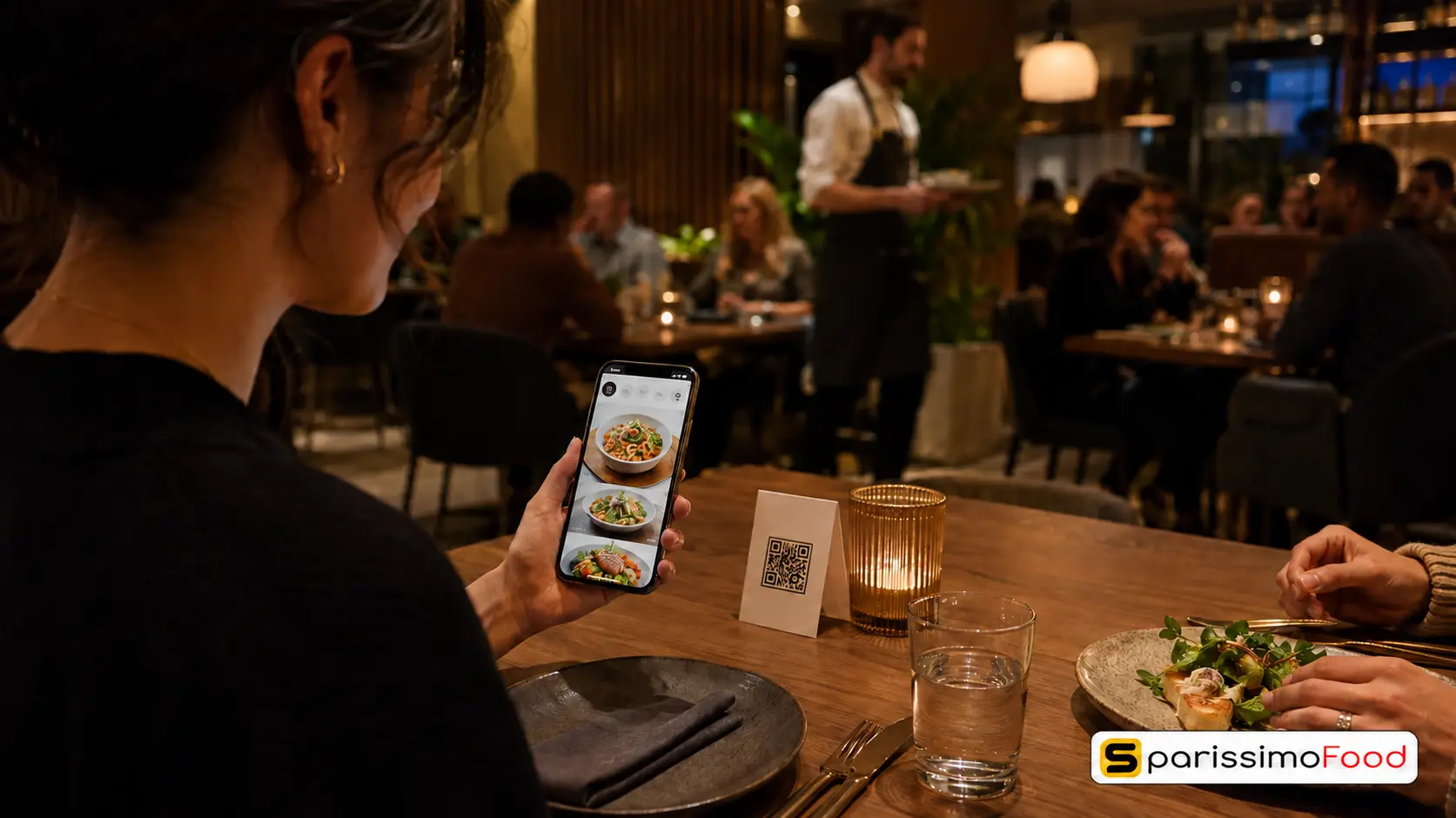
The version that works at that scale skips the separate app entirely. If a guest already orders through a QR code at the table or a link from a text message, the loyalty tracking should live in that same flow, not a fourth login they have to create. Roughly 5.9 million people in Switzerland actively use TWINT, so a reward that redeems automatically at TWINT checkout removes the exact friction, a separate app, a physical card, a code to remember, that the 35% frustration figure above is describing.
The second requirement is that the data belongs to the restaurant, not to a marketplace. A loyalty programme built on delivery-platform orders is tracking the wrong behaviour: those guests are the platform’s customers first, which is the same structural problem covered in our guide to converting delivery app guests into direct orders. A programme that only sees direct-channel orders, table QR, phone, your own website or app, sees the guest relationship you actually control.
The third requirement, under Swiss law specifically, is that once a loyalty programme is capturing a guest’s name, phone number, and order history to personalise rewards, the revised Data Protection Act (nDSG) governs how that data must be stored and used, separately from any marketing consent already covered by opt-in rules. This isn’t legal advice, so confirm the specifics with your own advisor, but a loyalty system built into your existing ordering platform, rather than a bolted-on third-party app, means that data question has one clear answer instead of three separate systems to audit.
The One Number That Tells You If Your Programme Is Working
Most restaurants judge a loyalty programme by how many people signed up. Signups measure curiosity, not loyalty. The number that actually answers the question is the second-visit rate: of the guests who redeemed a first reward, what percentage came back and ordered again within 30 days?
Second-Visit Rate = (members who visit again within 30 days of their first redemption) ÷ (total members who redeemed a first reward) × 100
There’s no universal healthy benchmark for this figure yet, because most restaurants have never measured it. That’s exactly the point: measuring it at all puts you ahead of most competitors, and comparing it against your own baseline repeat-visit rate tells you whether the programme is doing more than handing out free food to guests who’d have returned regardless.
Here’s what the underlying economics look like with real numbers. A restaurant with 500 enrolled loyalty members, a CHF 35 average order, and a baseline of 1.4 visits per member per month is generating CHF 24,500 a month from that group before the programme changes anything. A conservative 20% lift in visit frequency, well below the 22% national average found in the research above, brings that to 840 visits and CHF 29,400 a month: an incremental CHF 4,900 from guests you already had.
Funding that lift with a CHF 8 reward at a 10% redemption rate costs roughly CHF 672 a month against 84 redemptions. Net gain: close to CHF 4,200 a month, from the same 500 guests, with no acquisition spend at all. That gap is the entire case for loyalty done properly, and it collapses fast if the second-visit rate never gets measured.
How SparissimoFood Helps With Restaurant Loyalty Programmes
The requirements above, direct-channel data, no separate app, and a way to actually see the second-visit rate, only work if the loyalty tracking sits inside the same system as ordering rather than bolted on top of it.
Every order captured through SparissimoFood, whether from a QR code at the table, online checkout, or the branded app add-on, belongs to your restaurant and links back to the same guest record, which is what makes a milestone or spend-based reward, one of the five automated sequences covered in our SMS marketing guide, possible to trigger automatically instead of tracked on paper. Because TWINT is built into checkout natively, a reward redeems the moment a guest orders, without a second app or a card to carry.
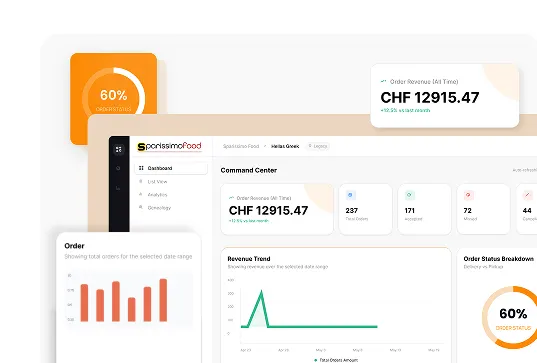
The manager dashboard shows repeat-guest activity in real time, so the second-visit rate above is a number you can check rather than estimate manually at the end of each month.
Pricing runs on the same predictable plans as the rest of the platform, not a separate loyalty subscription to reconcile: Starter at CHF 49/month with an 8% commission, Business at CHF 79/month with 5%, and Professional at CHF 148/month, also at 5%. None of that is commission-free, but it means loyalty tracking, ordering, and guest data all sit in one system instead of three.
The 14-day free trial requires no credit card, enough time to enrol a first batch of guests and check whether the second-visit rate above actually moves.
Frequently Asked Questions
Do restaurant loyalty programmes actually increase revenue?
Yes, when they redirect visits toward the enrolled restaurant rather than simply rewarding guests who were coming back anyway. Loyalty members visit their enrolled restaurant brands at roughly twice the rate of non-members and made up 39% of all restaurant visits in 2024, up from about half that share in 2019.
Why do most restaurant loyalty programmes fail?
The two most cited reasons are friction and fragmentation. Around 35% of loyalty members say complicated point accumulation and expiring rewards are their biggest frustration, and two-thirds belong to two or more competing programmes at once, so a generic points card rarely earns real exclusivity on its own.
How much should a loyalty reward cost a restaurant?
There’s no fixed percentage, but the reward cost needs to stay well below the incremental revenue it generates. In a worked example with 500 members and a CHF 35 average order, a CHF 8 reward redeemed by 10% of visits costs around CHF 672 a month against roughly CHF 4,900 in incremental revenue from a modest 20% visit-frequency lift.
Should a small restaurant use a digital loyalty programme or a physical stamp card?
A digital programme tied to actual ordering data, rather than a stamp card nobody tracks centrally, is the only version that lets you measure whether it’s working. A physical card can capture a repeat visit, but it can’t tell you a second-visit rate, trigger a timely follow-up, or connect to how a guest actually orders.
How long does it take to know if a new loyalty programme is working?
The clearest early signal comes within the first 30 days after a guest’s first reward redemption: guests re-engaged in that window increase their visit frequency by around 38%, while guests who aren’t typically never redeem a second reward. Watch the 30-day window and the fourth-visit mark, not total signups, in a programme’s first quarter.
A loyalty programme doesn’t create a hungry guest; it decides whether that guest’s next visit goes to you or to whoever remembered to ask first.

.Ds4FHhSq_ZxC9WE.webp "Restaurant Upselling Techniques That Don't Feel Pushy")




.CXCr6fQt_Z11gsYh.webp "Build a Branded Restaurant App Without Developers")
.y09Xtv8Z_1gH6f6.webp "Set Up Restaurant Online Ordering in Under a Week")
.B-Rl4IDw_Z204OoN.webp "Restaurant Loss Prevention and Theft Guide")

.DPpk5JZR_AlrVy.webp "Restaurant Communication During Peak Hours | Guide 2026")



.B6eEizW1_Z2bHQYl.webp "Restaurant Menu Pricing Strategies That Actually Protect Your Margins in 2026")
.CRszlDy5_2neUXu.webp "How to Migrate from GloriaFood Without Disruption: A Technical Step-by-Step Guide")
.kT6N2QP-_1Tp2j1.webp "GloriaFood Is Shutting Down on April 30, 2027 — What Every Restaurant Owner Needs to Do Now")