
In-House vs Third-Party Delivery for Swiss Restaurants | 2026
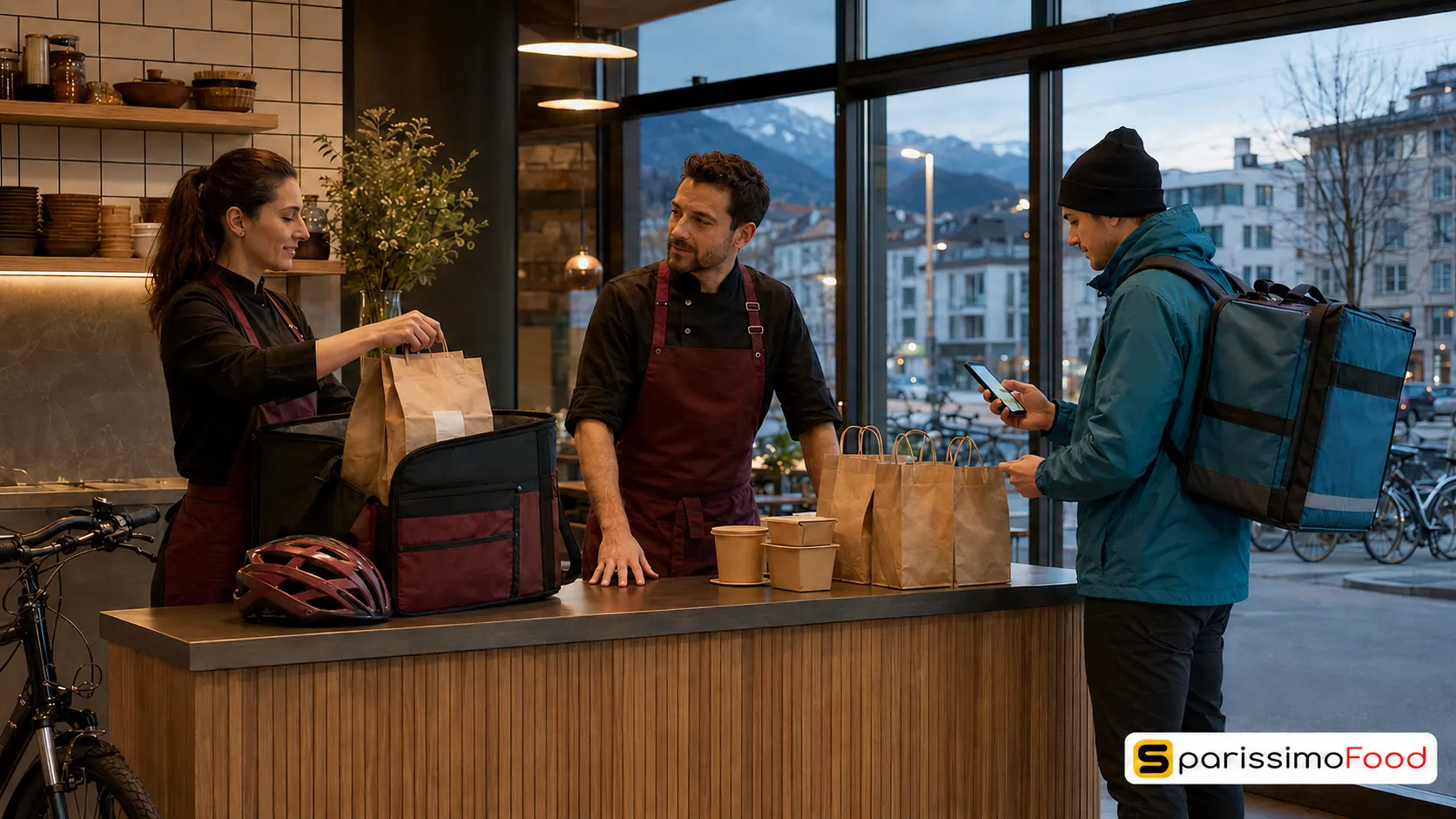

Quick Answer: Neither in-house delivery nor third-party platforms are categorically more profitable for Swiss restaurants. The answer depends on one number: how many delivery orders your restaurant processes per hour during your delivery window. In-house delivery becomes financially viable in Switzerland when your kitchen generates six or more delivery orders per hour consistently. Below that threshold, the cost of a Swiss delivery driver (CHF 25–31 per hour including social contributions) exceeds the commission you would pay on the same orders through Just Eat or Uber Eats. The most profitable model for the majority of independent Swiss restaurants is neither extreme: it is a direct ordering platform with a lower commission rate, combined with either in-house drivers at sufficient volume or a flexible courier arrangement below that threshold.
Every Swiss restaurant offering delivery eventually faces the same question: is it better to manage your own drivers or pay Just Eat, Uber Eats, and their equivalents to deliver for you?
Most answers to this question are too simple. They compare “commission fees” against “driver costs” as if those numbers are fixed. They are not. The correct answer depends on your order volume, your delivery radius, your average order value, and whether you have access to a direct ordering channel that changes the commission economics entirely.
This article walks through every variable using Swiss CHF figures, so you can run the calculation for your own restaurant.
Understanding the Three Delivery Models Available to Swiss Restaurants
Most guides frame this as a binary choice. In practice, Swiss restaurant operators have three distinct delivery models available to them.
Model 1: Third-party platform, platform couriers. You list on Just Eat or Uber Eats. When an order comes in, a platform courier collects and delivers it. You pay 25–30% commission on the order value. You do not need drivers, vehicles, or delivery infrastructure. Your commission rate is the highest of the three models.
Model 2: Third-party platform, your own drivers. You list on Just Eat or another platform but use your own delivery drivers to fulfil the orders. You pay 10–15% commission to the platform for the listing and order flow, plus the direct cost of your driver’s time and vehicle. Your commission rate is lower, but you carry the operational burden of managing a delivery team.
Model 3: Direct ordering platform, flexible delivery. Customers order through your own branded channel, typically a website or app, at a commission rate significantly below the major platforms. You choose delivery fulfilment separately: your own drivers, a third-party courier network, or a combination. You own all customer data from every order.
Most guides discuss only Models 1 and 2. Model 3 is the one that changes the profitability picture for the majority of Swiss independent restaurants, and it is the one this article gives the most attention.
For the full breakdown of what Just Eat actually charges Swiss restaurants under each model, see our detailed Just Eat commission guide.
The Cost of Model 1: Third-Party Platform with Platform Couriers
This is the simplest model operationally and the most expensive per order.
When Just Eat’s couriers deliver your food, you pay 25–30% of the order value in commission. Add payment processing fees of approximately 1.8% and typical packaging costs of CHF 1.50 per order, and the total cost structure on a CHF 40 order looks like this:
| Cost Item | CHF |
|---|---|
| Just Eat commission (28%) | 11.20 |
| Payment processing (1.8%) | 0.72 |
| Packaging | 1.50 |
| Food cost (30%) | 12.00 |
| Net revenue before overhead | 14.58 |
The restaurant retains CHF 14.58 from a CHF 40 order before rent, utilities, or kitchen labour. On high-volume nights with premium order values, this can still produce a net margin. On low-volume periods or with smaller orders, it does not.
What this model provides in return: zero investment in vehicles, insurance, or driver management; access to a large existing customer base on the platform; and no minimum order threshold required to make the economics work. For new restaurants or those with inconsistent delivery volume, this accessibility has genuine value.
What it costs beyond commission: every customer who orders through Just Eat is a customer whose contact details you will never receive. After 1,000 orders through the platform, you have 1,000 unknown customers you cannot market to, cannot retain with a loyalty program, and cannot reach when they stop ordering.
The Cost of Model 2: Third-Party Platform with Your Own Drivers
This model reduces your platform commission significantly. Just Eat charges 10–15% when your own drivers handle delivery. But it introduces the cost of those drivers, which in Switzerland is substantial.
The Swiss Driver Cost Calculation
Under the L-GAV collective labour agreement for Swiss hospitality and service workers, delivery drivers in Switzerland cost restaurants CHF 23–27 per hour in gross wages including mandatory social contributions. Add vehicle or e-bike costs of CHF 2–4 per hour, and the total cost of operating a driver is CHF 25–31 per hour.
At six deliveries per hour (a realistic rate for a dense urban area), the cost per delivery is:
| Deliveries per hour | Cost per delivery | Verdict |
|---|---|---|
| 2–3 | CHF 10.00–15.50 | Model 1 is cheaper |
| 4–5 | CHF 6.25–7.75 | Approximate break-even |
| 6+ | CHF 4.50–5.20 | Model 2 is cheaper |
The full cost structure on a CHF 40 order at six deliveries per hour looks like this:
| Cost Item | CHF |
|---|---|
| Just Eat commission (13%) | 5.20 |
| Driver cost (6 orders/hour) | 4.75 |
| Payment processing (1.8%) | 0.72 |
| Packaging | 1.50 |
| Food cost (30%) | 12.00 |
| Net revenue before overhead | 15.83 |
Net revenue improves from CHF 14.58 in Model 1 to CHF 15.83 in Model 2, a gain of CHF 1.25 per order. At 60 orders per day, that is CHF 75 per day, or CHF 27,375 per year.
But this calculation assumes six deliveries per hour, every hour of every delivery window. In practice, delivery volume is uneven. A restaurant that achieves six orders per hour during Friday dinner service may achieve only two or three during a quiet Tuesday lunch. During those slow periods, in-house delivery costs more than platform couriers.
What In-House Delivery Actually Requires in Switzerland
Beyond the driver wage, establishing in-house delivery in Switzerland involves several fixed costs that the per-order calculation does not capture:
Vehicle purchase or lease. An e-bike suitable for food delivery costs CHF 2,500–4,500 to purchase, or CHF 80–150 per month to lease. Insulated delivery bags add CHF 150–300 per driver.
Insurance. Commercial delivery vehicle insurance in Switzerland for an e-bike runs CHF 300–600 per year. Liability insurance for food delivery adds further cost.
Driver recruitment and management. Finding, vetting, and scheduling part-time delivery drivers in Switzerland’s tight labour market is a significant ongoing operational cost that does not appear in per-order calculations.
Technology for order dispatch and driver tracking. A route optimization and dispatch system adds CHF 50–200 per month depending on the platform.
These fixed costs mean in-house delivery only makes financial sense when your restaurant generates consistent, high-density delivery order volume across most of your delivery window, not just during peak periods.
The Case for the Hybrid Model
The most profitable Swiss restaurant delivery operations are rarely fully committed to either model. They use third-party platform couriers during periods of low order density, and their own drivers during peak periods when six-plus orders per hour is achievable.
This hybrid approach requires active management: someone monitoring the order flow in real time and making decisions about which orders to assign to in-house drivers versus leaving for platform couriers. It is more complex than a single-model approach, but for restaurants with both a delivery platform presence and their own driver capacity, it is significantly more profitable than either extreme.
The hybrid model also preserves the discovery benefit of the platforms (new customers find you through the Just Eat listing) while minimizing the commission cost on high-volume periods (your own drivers handle the Friday dinner rush).
Model 3: Direct Ordering Platform Plus Flexible Delivery
This is the model that most articles on this topic do not adequately address, because it requires a shift in how you think about the delivery channel.
In Models 1 and 2, the platform generates orders and takes a commission. In Model 3, your own direct ordering channel generates orders at a lower commission rate, and you choose delivery fulfilment separately, either with your own drivers or a third-party courier network.
The cost structure on a CHF 40 order through a direct ordering platform at 8% commission, with your own driver at six deliveries per hour:
| Cost Item | CHF |
|---|---|
| Direct platform commission (8%) | 3.20 |
| Monthly platform fee (allocated per order) | 0.05 |
| Driver cost (6 orders/hour) | 4.75 |
| Payment processing (1.5%) | 0.60 |
| Packaging | 1.50 |
| Food cost (30%) | 12.00 |
| Net revenue before overhead | 17.90 |
Net revenue of CHF 17.90 compares to CHF 14.58 under Model 1 and CHF 15.83 under Model 2. The additional CHF 3.32 per order over Model 1 represents CHF 199 per day at 60 orders and CHF 72,635 per year.
Critically, this model also gives your restaurant the contact data of every customer who orders, enabling the email and SMS re-engagement that converts one-time delivery customers into long-term regulars. For the specific tactics to move customers from delivery apps to your direct channel, see our guide on converting delivery app customers.
The limitation of Model 3 is that it requires an established customer base who will find and use your direct channel. Restaurants with no delivery history or no marketing reach are better served starting with Model 1 for discovery, then transitioning to Model 3 as customer relationships develop.
Side-by-Side Comparison for Swiss Restaurants
| Factor | Model 1: Platform Couriers | Model 2: Own Drivers | Model 3: Direct + Own/Courier |
|---|---|---|---|
| Commission per order (CHF 40) | CHF 11.20 (28%) | CHF 5.20 (13%) | CHF 3.20 (8%) |
| Driver cost per order | CHF 0 | CHF 4.75 | CHF 4.75 (own) or CHF 5–7 (courier) |
| Net per order (before overhead) | CHF 14.58 | CHF 15.83 | CHF 17.90 |
| Customer data ownership | None | None | Full |
| Discovery for new customers | High | Moderate | Requires own marketing |
| Minimum viable order volume | Any | 6+ orders/hour | Established customer base |
| Upfront investment | Zero | CHF 3,000–6,000+ | Low (platform subscription) |
| Best for | New restaurants, low volume | High-volume, dense areas | Established restaurants with repeat customers |
How to Choose the Right Model for Your Restaurant
If your restaurant is new or has less than 30 delivery orders per day: Start with Model 1. The discovery value of the platform is real, and your order density does not support in-house delivery economics. Focus on building order volume and identifying repeat customers.
If your restaurant processes 30–60 delivery orders per day consistently: Model 2 or a hybrid approach is worth evaluating. Run your delivery volume data against the break-even table. If your peak periods reliably reach six orders per hour, a part-time in-house driver during those windows reduces your cost per order meaningfully.
If your restaurant processes more than 60 delivery orders per day with consistent volume: Model 3 plus in-house delivery is your most profitable structure. The CHF benefit of the lower commission compounded across that volume is substantial, and your customer base is large enough to generate direct ordering traffic. For the broader profitability context, see our restaurant profitability guide.
If your restaurant is in a dense urban area (central Zurich, Geneva, Basel): In-house delivery economics are more favorable because delivery radius is shorter, driver time per order is lower, and orders-per-hour rates are more achievable.
If your restaurant is in a suburban or smaller-town location: Your delivery radius is likely larger, orders per hour will be lower, and the economic case for in-house delivery is harder to sustain. Model 1 or a third-party courier arrangement through a direct platform is likely more practical.
How SparissimoFood Fits Into Each Model
SparissimoFood is the direct ordering platform that enables Model 3 for Swiss restaurants.
Lower commission per order. SparissimoFood starts at CHF 49/month with a commission of 8% per order on the Starter plan, and CHF 79/month at 5% commission on the Business plan. Compared to the 25–30% charged by Just Eat or Uber Eats couriers, every direct order through SparissimoFood recovers CHF 7–8 in gross margin on a typical CHF 40 order.
Flexibility on delivery fulfilment. SparissimoFood does not require you to commit to a specific delivery model. You can take orders through the platform and fulfil them with your own drivers, with a third-party courier service, or in a hybrid arrangement that varies by time of day and order volume. The ordering channel and the delivery fulfilment are separate decisions.
Customer data ownership. Every customer who orders through SparissimoFood provides their email address and phone number, which remain your property permanently. This is the data asset that makes the conversion tactics in Model 3 possible, and it is what separates direct ordering from a platform listing.
TWINT integration. SparissimoFood supports TWINT natively across all order types. Swiss customers who use TWINT complete their checkout faster, abandon their carts less frequently, and represent the payment preference of a majority of Swiss digital shoppers.
Kitchen throttling. When delivery orders arrive faster than your kitchen can process them, SparissimoFood allows your team to pause or extend delivery windows with a single action, regardless of which delivery fulfilment model you are running. This protects food quality and kitchen capacity without requiring manual intervention on multiple platforms.
Explore the current plan options at manage.sparissimofood.com/plans.
Frequently Asked Questions
Is in-house delivery always more profitable than using third-party platforms? No. In-house delivery is more profitable than platform courier delivery only when your restaurant achieves six or more delivery orders per hour consistently during delivery windows. In Switzerland, the cost of a delivery driver including social contributions runs CHF 25–31 per hour. Below six orders per hour, the per-delivery cost of your own driver exceeds the commission you would pay to a platform courier for the same orders.
What is the break-even delivery volume for in-house delivery in Switzerland? The break-even point where in-house delivery costs approximately the same as a third-party courier arrangement (at a 13% platform commission for using your own drivers on Just Eat) is around four to five delivery orders per hour. Below that rate, platform couriers are cheaper. Above six orders per hour consistently, in-house delivery is meaningfully cheaper per order.
Can I use a direct ordering platform and still have my food delivered by Just Eat drivers? It depends on your platform arrangement. Some direct ordering platforms allow you to arrange third-party courier fulfilment separately. This lets you use a direct channel for order intake (lower commission, customer data ownership) while using courier networks for delivery in periods or areas where your own drivers are not cost-effective.
How much does in-house delivery cost to set up in Switzerland? The initial investment for a single delivery driver in Switzerland includes an e-bike or scooter (CHF 2,500–4,500 to purchase or CHF 80–150/month to lease), commercial delivery insurance (CHF 300–600/year), insulated delivery equipment (CHF 150–300), and potentially dispatch software (CHF 50–200/month). Beyond the initial investment, ongoing costs include the driver’s gross wage and social contributions at CHF 25–31 per hour of operation.
What is the most profitable delivery model for a small independent Swiss restaurant? For a small restaurant processing fewer than 30 delivery orders per day, the most practical model is a third-party listing with platform couriers for discovery and volume building, combined with a direct ordering channel for repeat customers. As direct order volume grows, the economics of adding in-house delivery during peak periods become increasingly favorable. The goal is to reduce dependence on platform couriers over time by shifting repeat customers to the direct channel, where the commission is lower and the customer relationship is owned.
In Swiss restaurant delivery, the most profitable model is not the cheapest to start. It is the one you can sustain at the volume you actually generate.

.Ds4FHhSq_ZxC9WE.webp "Restaurant Upselling Techniques That Don't Feel Pushy")



.CXCr6fQt_Z11gsYh.webp "Build a Branded Restaurant App Without Developers")
.y09Xtv8Z_1gH6f6.webp "Set Up Restaurant Online Ordering in Under a Week")
.B-Rl4IDw_Z204OoN.webp "Restaurant Loss Prevention and Theft Guide")
.DPpk5JZR_AlrVy.webp "Restaurant Communication During Peak Hours | Guide 2026")

.B6eEizW1_Z2bHQYl.webp "Restaurant Menu Pricing Strategies That Actually Protect Your Margins in 2026")
.CRszlDy5_2neUXu.webp "How to Migrate from GloriaFood Without Disruption: A Technical Step-by-Step Guide")
.kT6N2QP-_1Tp2j1.webp "GloriaFood Is Shutting Down on April 30, 2027 — What Every Restaurant Owner Needs to Do Now")