
How to Price a Restaurant Menu | Switzerland Guide 2026

Quick Answer: Pricing a restaurant menu correctly requires four sequential steps: (1) build a standardised recipe card and calculate the exact ingredient cost per dish; (2) estimate your labour contribution per dish and calculate your prime cost (ingredients + labour); (3) apply a pricing formula: the food cost percentage method gives you: Menu Price = Ingredient Cost ÷ Target Food Cost %. For Swiss restaurants, target food cost should sit between 27% and 32%, not the 33% often cited in US-focused guides, because Swiss labour costs consume 35–40% of revenue versus 28–32% in most other markets; (4) verify the result against local competitive pricing and adjust. A price that covers your costs but sits 40% above every competitor in your street will not work. Both checks are required.
A restaurant that fills every table but loses money on most dishes is not an operational problem. It is a pricing problem. Most Swiss restaurant owners set menu prices once, at opening or after a refurbishment, and then leave them unchanged for two or three years while ingredient costs keep rising. According to data from the Swiss Federal Statistical Office, food wholesale prices in Switzerland rose 11.4% between 2022 and 2025. A menu priced in 2023 is generating 5–8 percentage points less margin today than its owner believes.
Pricing is not a one-time task. It is a quarterly discipline.
The Three Cost Layers Behind Every Menu Price
Before touching a single price, you need to understand the three costs your menu must cover. Missing any one of them produces a number that looks profitable on paper and destroys margin in practice.
Layer 1: Ingredient cost (food cost). The direct cost of all raw materials needed to make one portion of a dish, including garnishes, sauces, oils, and packaging for delivery orders. This is the only cost most operators calculate.
Layer 2: Labour cost. The portion of your total kitchen and service wage bill attributable to preparing and serving each dish. In Switzerland, where a full-time kitchen employee earns CHF 52,000–68,000 per year and service staff CHF 46,000–58,000. Labour is the largest single cost in your business. It cannot be excluded from pricing.
Layer 3: Overhead and target profit. Rent, utilities, insurance, platform subscriptions, marketing, equipment maintenance, and your target net profit margin. Swiss restaurant profit margins typically range from 3% to 9%. Build profit in intentionally. It does not appear automatically after other costs are subtracted.
Every menu price must cover all three layers. The formula connects them.
Step 1: Cost Every Dish With a Standardised Recipe Card
The starting point for any correct menu price is an accurate, portion-specific recipe card for every dish. Not an approximation. Not a memory of what the head chef usually uses. A written, costed document.
A standardised recipe card records:
- Every ingredient, by weight (in grams or millilitres)
- The current purchase price per kilogram or litre
- The yield factor, meaning how much usable product you get after trimming, cooking, and portioning (a whole chicken that costs CHF 7.00/kg yields roughly 65% usable meat, making the actual cost CHF 10.77/kg of usable portion)
- The cost per ingredient per portion
- The total ingredient cost per portion
Without standardised recipes, you cannot price accurately, cannot control food cost consistently, and cannot train kitchen staff to reproduce the dish reliably. Recipe standardisation and menu pricing are inseparable. For guidance on building a recipe management system for your kitchen, see our restaurant recipe management guide.
Worked Example: Pasta Carbonara in CHF
| Ingredient | Quantity per portion | Purchase price | Yield factor | Cost per portion |
|---|---|---|---|---|
| Spaghetti | 150g | CHF 2.50/kg | 100% | CHF 0.38 |
| Pancetta | 80g | CHF 22.00/kg | 95% | CHF 1.85 |
| Egg yolks (2) | 40g | CHF 4.50/6-pack | 100% | CHF 0.75 |
| Pecorino Romano | 30g | CHF 28.00/kg | 100% | CHF 0.84 |
| Black pepper, salt | n/a | n/a | n/a | CHF 0.05 |
| Total ingredient cost | | | | CHF 3.87 |
This is your food cost per portion: CHF 3.87. This is the number that goes into your pricing formula.
Two important notes on this calculation. First, use your current actual purchase prices, not last year’s prices. If you last costed this dish in 2023 and pancetta has gone up 18% since, your costing is wrong. Second, include portioning losses. If you buy a 500g block of Pecorino and regularly lose 20g to rind, cost 120g of purchase to get 100g of usable product (CHF 28.00/kg × 1.20 = effective cost of CHF 33.60/kg of usable Pecorino).
Step 2: Add Your Labour Factor, the Step Most Owners Skip
Every competitor article on menu pricing will give you the food cost percentage formula. Almost none of them tell you to include labour in your dish-level cost calculation. In the US, where labour costs run 28–32% of revenue, you can apply a standard food cost target and implicitly cover labour. In Switzerland, where labour runs 35–40% of revenue, you cannot.
The prime cost method combines ingredient cost and dish-level labour cost into a single number before applying your formula.
Prime Cost per Dish = Ingredient Cost + Labour Cost per Dish
To estimate labour cost per dish, you need two numbers: the total time (in minutes) required to prepare and plate one portion, and your blended hourly wage rate. For a Swiss casual dining kitchen, a blended rate of CHF 35–40 per hour (combining cooks, prep staff, and a portion of kitchen management) is a reasonable working figure.
Continuing the Pasta Carbonara example:
| Labour component | Time | Cost at CHF 37/hour |
|---|---|---|
| Mise en place (proportional allocation) | 4 minutes | CHF 2.47 |
| Active cooking and plating | 8 minutes | CHF 4.93 |
| Total labour cost per portion | 12 minutes | CHF 7.40 |
Prime cost = CHF 3.87 (ingredients) + CHF 7.40 (labour) = CHF 11.27
The prime cost target for a sustainable Swiss restaurant is 60–65% of the menu price. This leaves 35–40% to cover overhead and generate profit.
Menu price (prime cost method) = Prime Cost ÷ 0.62 = CHF 11.27 ÷ 0.62 = CHF 18.18
Round to CHF 18.50. This aligns well with what a casual Italian restaurant in Zurich would realistically charge for a Carbonara, grounded in what it actually costs to make and serve.
Step 3: Apply the Pricing Formula and Verify the Result
Once you have your ingredient cost and prime cost, you have two pricing methods available. Use both and compare the results.
Method A: The Food Cost Percentage Formula
Menu Price = Ingredient Cost ÷ Target Food Cost Percentage
For Swiss restaurants, the target food cost should be 27–30%, not the 33% often cited in US-focused guides. Swiss labour costs are too high for 33% food cost to leave a viable margin.
Pasta Carbonara: CHF 3.87 ÷ 0.29 = CHF 13.34
This gives you a lower bound: the minimum price at which your ingredient cost is within target. It does not include the full labour burden. This is why the prime cost method (Step 2) typically gives a more accurate minimum price for Swiss operators.
Method B: The Gross Profit Check
Once you have a candidate price, verify it with the gross profit margin formula:
Gross Profit Margin = (Menu Price − Ingredient Cost) ÷ Menu Price × 100
At CHF 18.50 for the Carbonara: (CHF 18.50 − CHF 3.87) ÷ CHF 18.50 × 100 = 79%
A gross profit margin of 79% on a pasta dish is strong. From that 79%, you still need to cover labour (contributing CHF 7.40), overhead, and profit. The net picture:
| Revenue | CHF 18.50 |
|---|---|
| Ingredient cost | −CHF 3.87 |
| Labour cost | −CHF 7.40 |
| Gross after prime cost | CHF 7.23 |
| Overhead (est. 15% of price) | −CHF 2.78 |
| Net per dish | CHF 4.45 |
CHF 4.45 net on a CHF 18.50 Carbonara is a 24% net margin per dish, above the Swiss restaurant average. A dish like this is worth promoting.
Step 3B: The Competitive Check
Cost-based pricing gives you a floor. Market pricing gives you a ceiling. Your final price sits between them.
Once you have your cost-based minimum, research what two or three comparable restaurants in your area charge for the same or similar dish. If your minimum is CHF 14 and local comparables charge CHF 20–24, you have room. If your minimum is CHF 22 and local comparables charge CHF 18–20, you have a structural problem: either your costs are too high, or the dish does not belong on your menu at this format.
Never price below your cost-based minimum. Never price more than 20% above your local market comparables without a clear premium reason (your setting, your sourcing, your brand). For a deeper analysis of the psychological and strategic elements of menu pricing, including anchoring, decoy pricing, and channel-specific pricing. See our restaurant menu pricing strategies guide.
Category-Specific Pricing Rules for Swiss Menus
Different categories have different cost structures. Applying the same food cost target to every item on your menu is one of the most common and costly pricing mistakes.
Main courses: 28–32% food cost target. Proteins are expensive. Execution time is highest. Aim for 28–30% for dishes with premium proteins (veal, beef, fresh fish), 30–32% for pasta, risotto, and vegetarian mains.
Starters and salads: 22–28% food cost target. Lower ingredient costs and shorter prep time mean starters can carry lower food cost percentages, and they frequently do. A CHF 5 starter with CHF 1.20 of ingredients at 24% food cost is more profitable per franc than a CHF 45 steak at 34% food cost.
Desserts: 22–27% food cost target. Desserts are often underpriced. A CHF 2.00 ingredient cost for a tarte tatin priced at CHF 9.50 runs 21% food cost with high gross contribution. Desserts are your highest-opportunity-per-plate category.
Beverages: 15–25% food cost target. This is the most important category rule. A bottle of Chasselas purchased for CHF 8.00 and sold for CHF 36.00 runs 22% food cost and contributes CHF 28.00 in gross profit. A soft drink purchased for CHF 0.60 and sold for CHF 4.50 runs 13% food cost. Your beverage margin funds your kitchen.
Never let your blended food cost percentage across all categories rise above 30% in a Swiss context. If it is, your category mix or pricing is wrong, and delivery platform commissions will turn every third-party order into a loss. For the full breakdown of what Just Eat and Uber Eats commissions actually cost per order, see our guide on Just Eat commission costs in Switzerland.
When and How to Review Your Menu Prices
Swiss food wholesale prices rose 11.4% between 2022 and 2025 according to the Swiss Federal Statistical Office. A restaurant that priced its menu in 2023 and has not reviewed it since is now operating with a food cost percentage 3–5 percentage points above its original target, often without knowing it.
Review frequency: Every six months at minimum. Set a fixed calendar date, for example 1 March and 1 September, and re-cost your ten highest-volume dishes at current prices. If any have drifted more than 3 percentage points above your food cost target, reprice immediately.
Trigger reviews: When a key ingredient rises more than 15% in cost, act within 30 days. Do not absorb the hit and plan to fix it later. Later rarely comes, and the cumulative erosion from three or four unaddressed ingredient increases compounds quickly.
How to communicate price changes to guests: Do not apologise for price increases. State them clearly and, where appropriate, briefly. A short line on your website or menu, such as “Prices updated June 2026 to reflect current ingredient costs”, is honest and sufficient. Guests in Switzerland broadly understand and accept price increases when they are not hidden. What erodes trust is when prices increase without acknowledgement or when quality clearly does not match the price.
Update your delivery platform menus simultaneously. An inconsistency between your in-house menu and your Just Eat menu is confusing for guests and often results in complaints that damage your review score.
How SparissimoFood Helps You Price and Manage Your Menu
Correct menu pricing depends on two things: knowing your costs exactly and being able to apply different prices across different sales channels without operational chaos. SparissimoFood supports both.
Menu Builder. SparissimoFood’s menu management tools let you update item prices, add descriptions and photos, and restructure categories, all managed from a single dashboard. When you run a pricing review and need to adjust 15 items, this takes minutes rather than hours across multiple disconnected systems.
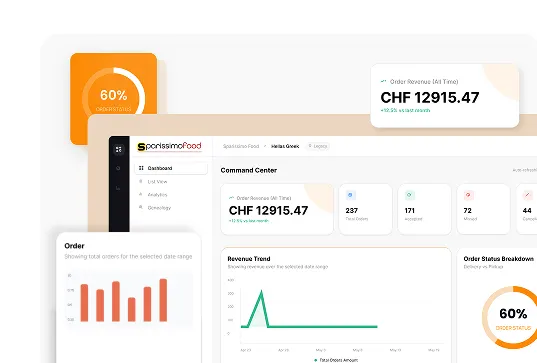
Analytics Dashboard. SparissimoFood’s manager dashboard shows you real-time order data, including which items are selling, at what volume, and when. This data is the practical input for your pricing decisions: if a dish is selling at 5x the rate of everything else, it is either priced too low or genuinely popular, and that distinction matters for your pricing review.
Multi-Channel Pricing. One of the most margin-critical decisions for a Swiss restaurant in 2026 is whether to charge different prices on delivery platforms versus your direct channel. SparissimoFood enables independent pricing by channel: your in-house price, your direct ordering price, and your aggregator price can all differ. This directly protects the margin your cost-based pricing was designed to produce. SparissimoFood starts at CHF 49/month with a commission of 5–8% per order, substantially lower than the 10–30% charged by Just Eat or Uber Eats. Shifting even a portion of your delivery orders to your direct channel improves the net return on every dish you have carefully priced.
Explore the current plan options at manage.sparissimofood.com/plans.
Frequently Asked Questions
What food cost percentage should Swiss restaurants target? Swiss restaurants should target a food cost percentage of 27–30%, which is lower than the 28–35% often cited in US or UK industry guides. The reason is labour costs: Swiss kitchen and service staff wages are among the highest in Europe, consuming 35–40% of revenue. A food cost of 33% on top of 38% labour leaves only 29% for all overhead and profit, which is not sustainable in Switzerland’s cost environment.
What is prime cost and why does it matter for menu pricing? Prime cost is the sum of ingredient cost (food cost) and direct labour cost for a dish or for the restaurant as a whole. It is a more complete cost measure than food cost alone. For Swiss restaurants, a healthy prime cost target is 60–65% of revenue (combining both food and labour). When you price only to a food cost percentage, you may hit your food cost target while your total prime cost exceeds 70%, leaving nothing for overhead and profit.
How do I calculate the food cost for a single menu item? List every ingredient in one portion of the dish, with its exact quantity in grams or millilitres. Look up the current purchase price per kilogram or litre for each ingredient. Apply any yield factor (loss from trimming, cooking, or portioning). Multiply quantity by price per unit for each ingredient and sum them. That total is your food cost per portion. For dishes with shared components (stocks, sauces), allocate a proportional cost per portion.
How often should I update my restaurant menu prices? At minimum, review and re-cost your ten highest-volume dishes every six months. Conduct a trigger review any time a key ingredient rises more than 15% in cost. Swiss food wholesale prices rose 11.4% between 2022 and 2025, and restaurants that have not reviewed prices since 2023 are almost certainly operating above their target food cost without realising it.
What is the difference between food cost percentage and gross profit margin? Food cost percentage measures what proportion of a dish’s selling price goes to ingredients: Food Cost % = Ingredient Cost ÷ Menu Price × 100. Gross profit margin measures what proportion of the selling price remains after ingredient cost: Gross Profit Margin = (Menu Price − Ingredient Cost) ÷ Menu Price × 100. The two are mirror images: a 30% food cost percentage corresponds to a 70% gross profit margin. Gross profit margin is useful for comparing absolute returns across dishes; food cost percentage is the standard tool for checking whether you are within your target cost structure.
Pricing your menu is not the least interesting part of running a restaurant. It is the arithmetic that decides whether everything else you do is worth it.

.Ds4FHhSq_ZxC9WE.webp "Restaurant Upselling Techniques That Don't Feel Pushy")




.CXCr6fQt_Z11gsYh.webp "Build a Branded Restaurant App Without Developers")
.y09Xtv8Z_1gH6f6.webp "Set Up Restaurant Online Ordering in Under a Week")
.B-Rl4IDw_Z204OoN.webp "Restaurant Loss Prevention and Theft Guide")


.DPpk5JZR_AlrVy.webp "Restaurant Communication During Peak Hours | Guide 2026")


.B6eEizW1_Z2bHQYl.webp "Restaurant Menu Pricing Strategies That Actually Protect Your Margins in 2026")
.CRszlDy5_2neUXu.webp "How to Migrate from GloriaFood Without Disruption: A Technical Step-by-Step Guide")
.kT6N2QP-_1Tp2j1.webp "GloriaFood Is Shutting Down on April 30, 2027 — What Every Restaurant Owner Needs to Do Now")