
Restaurant Recipe Management: How to Standardize Your Kitchen (2026 Guide)
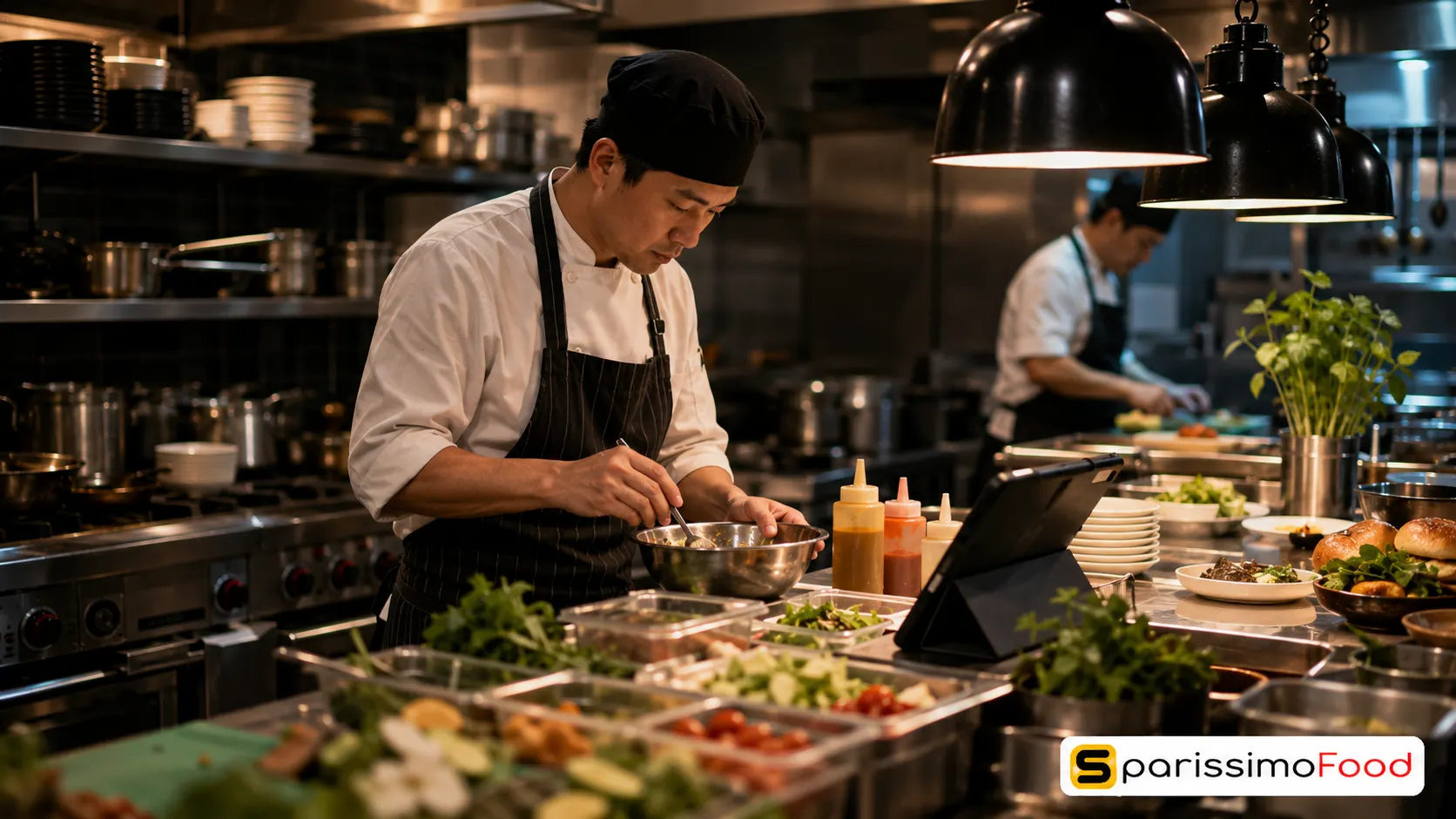

Quick Answer: Restaurant recipe management is the practice of documenting, costing, and maintaining every dish in a format that produces identical results regardless of which cook prepares it. A standardized recipe specifies ingredients by weight (not volume or habit), includes step-by-step preparation procedures, defines the exact plating standard, and records the food cost per portion. When recipes live in documented systems rather than in a chef’s memory, food quality becomes consistent, food costs become predictable, and the kitchen becomes trainable.
There is a version of this scenario playing out in thousands of restaurants every week. A long-serving head chef calls in sick. A line cook steps up. The Bolognese that regulars drive across the city for comes out thin. The portion sizes vary. A dish that normally costs CHF 4.20 to make costs CHF 5.80 tonight because nobody measured the protein.
The problem is not the line cook. The problem is that the recipe existed in one person’s head.
Restaurant recipe management is the system that prevents this. It is the difference between a kitchen that depends on a specific person and a kitchen that depends on a specific process. And when a kitchen depends on a process — not a person — it can scale, train new staff, control costs, and deliver the same guest experience every single service.
What Is Restaurant Recipe Management?
Restaurant recipe management is the complete system of documenting, standardizing, costing, and maintaining every dish on your menu. It covers:
- What goes into each dish — every ingredient, measured by weight
- How it is prepared — step-by-step, in the order it is executed
- How it is plated — with a reference photograph for every menu item
- What it costs — the exact ingredient cost per portion, updated when supplier prices change
- Where the recipe lives — in a central, accessible system that every authorized cook can retrieve
A recipe management system is not a folder of handwritten notes. It is a structured, living document that is tested, approved, and enforced as the operational standard of your kitchen.
Why Memory-Based Kitchens Break Down
Most independent restaurants run what is effectively a memory-based kitchen. The head chef holds the knowledge. Recipes are approximated through habit and experience. Portions are guided by feel. Results depend entirely on who is in the kitchen that day.
This model has three compounding problems:
1. Inconsistency destroys guest trust A guest who had an exceptional dish on their first visit and orders it again on their second expects the same experience. When the dish arrives slightly different — less seasoned, smaller portioned, differently plated — they notice. They may not complain. But they do not come back.
2. Uncontrolled food costs erode margins Without measured quantities, food cost per dish fluctuates with every service. A cook who is generous with protein by 30 grams per plate, across 40 covers, creates a food cost overrun that never appears as a single line item but silently compresses your margins every week.
3. Training becomes impossible to scale If the knowledge lives in one person, training a new cook means shadowing that person. This limits how fast you can grow, how quickly you can cover absences, and how reliably a second or third location can replicate the quality of the original.
The 6 Components of a Standardized Recipe
Every standardized recipe in your system must contain these six elements — no exceptions:
1. Recipe Name and Menu Reference Exactly as it appears on the menu. If the menu says “Rösti with Smoked Alpine Cheese,” the recipe is called exactly that — not “Rösti” or “cheese rösti” or any variation that causes confusion during service.
2. Yield and Portion Size Total quantity the recipe produces (e.g., “serves 10”) and the precise portion size per serving (e.g., “180g per plate”). Both by weight, not by visual estimation.
3. Ingredients Listed by Weight Every ingredient, measured in grams or kilograms. Not “a handful of herbs” or “a splash of wine.” Weight is the only measurement that is reproducible across different cooks, different days, and different locations.
4. Step-by-Step Preparation Method Instructions written in the order they are executed, specific enough that a cook who has never made this dish before can produce an acceptable result on the first attempt. Include cooking temperatures, timing, and equipment specifics (e.g., “grill at 220°C for 4 minutes per side”).
5. Plating Photo and Presentation Notes A reference photograph of the finished dish, taken from the same angle the guest sees it, with specific notes on garnish placement, sauce application, and any textural elements that must be visible. Every plate leaving the kitchen should be checked against this photograph during training and service.
6. Food Cost Per Portion The calculated ingredient cost of one serving, based on current supplier prices. This number must be updated whenever ingredient costs change significantly — not annually, but actively.
Step 1: Document Every Recipe by Weight, Not Habit
The first and most commonly resisted step in building a recipe management system is converting every measurement from approximation to weight.
“A handful of basil” needs to become “8g of fresh basil leaves.” “A knob of butter” needs to become “25g unsalted butter.” “Season to taste” needs to become “3g sea salt, adjust at pass.”
This is not about removing a chef’s creativity. It is about making that creativity reproducible.
How to approach the documentation process:
- Have the head chef prepare each dish while a second person documents every action and measurement in real time
- Weigh every ingredient as it is added — do not rely on memory at the end
- Run the documented recipe with a different cook immediately after, and compare the results
- Refine the documentation until the second cook’s output is indistinguishable from the first
This process takes time. For a menu of 25 items, plan for 2 to 3 weeks of structured documentation sessions. But it is a one-time investment that pays returns every service thereafter.
Step 2: Test Each Recipe Until Results Are Identical
A recipe is not standardized because the head chef wrote it down. It is standardized when three different cooks can follow the written instructions and produce results that are identical in taste, presentation, and portion size.
The testing protocol:
- Head chef prepares the dish from written instructions (not from memory) and assesses the result
- Senior line cook prepares the dish from the same written instructions without guidance
- Junior cook or new hire prepares the dish from the same written instructions
- All three results are compared and assessed against the reference photograph
Where the results diverge, the written instructions are unclear. The fix is always to the recipe document — not to tell the cook to “use better judgment.”
Equipment calibration: Testing reveals another critical issue: oven temperatures, grill temperatures, and fryer temperatures vary between units and drift over time. A recipe that specifies “bake at 180°C for 18 minutes” will produce different results on an oven that runs 12°C hot. Calibrate all key equipment as part of the standardization process and schedule regular recalibration.
Step 3: Calculate the Food Cost of Every Dish
A standardized recipe with no cost attached is half a system. The food cost per portion is what connects your kitchen operations to your financial health.
How to calculate food cost per portion:
- List every ingredient in the recipe with its weight per portion
- For each ingredient, calculate the cost per gram based on your current supplier invoice
- Sum the ingredient costs to get the total food cost per portion
- Divide by the menu selling price to get your food cost percentage
Example: A pasta dish uses 180g of fresh pasta (CHF 0.90), 120g of cream sauce base (CHF 0.65), 80g of smoked salmon (CHF 2.40), and 5g of garnish herbs (CHF 0.12). Total food cost: CHF 4.07. Selling price: CHF 22.00. Food cost percentage: 18.5%.
Knowing this number — for every dish on your menu — lets you make pricing and menu engineering decisions based on data rather than instinct. It also tells you immediately when a cost change from a supplier is materially affecting your margin, because the impact shows up in the recipe cost before it shows up in your monthly P&L.
Step 4: Train Staff Using the Recipe, Not the Chef
Once recipes are documented and tested, training changes fundamentally. New kitchen staff are no longer trained by watching and imitating a senior cook. They are trained by following a documented process and being assessed against a standard.
Recipe-based training protocol:
- New cook reads the full recipe before touching any equipment
- New cook prepares the dish while the trainer observes — the trainer does not intervene unless there is a food safety issue
- The finished dish is assessed against the reference photograph and tasted against the standard
- The new cook repeats the preparation until results meet the standard
- Sign-off is recorded: the cook is certified to prepare this dish on the line
Ongoing enforcement: Standardization only holds if it is actively maintained. Assign one person — the head chef or kitchen manager — the responsibility of spot-checking plated dishes against reference photographs during service at least twice per week. When drift is identified, the correction is immediate and specific: “the sauce is 15g over portion — here is the portion weight.”
Step 5: Store and Update Recipes in One Central System
Recipes in a physical binder on a shelf get damaged, go missing, and are not accessible when a chef needs them mid-service. Recipes stored in different formats across different devices create version control problems: which version is current? Which was updated last month?
A recipe management system needs a single source of truth. Every authorized team member accesses the same version. Updates are made centrally and immediately visible to everyone.
What to look for in a recipe storage system:
- Searchable by dish name, ingredient, or category
- Accessible on a tablet or phone in the kitchen environment
- Editable with version history — so you can see when a recipe was changed and what the previous version was
- Able to attach photographs directly to each recipe entry
- Able to auto-calculate food cost when supplier prices are updated
For multi-location operations, the system must be cloud-based. A head chef at one location who updates a recipe should not need to email a PDF to three other sites. The update should be visible everywhere immediately.
How SparissimoFood Connects Recipe Management to Your Online Menu
Recipe standardization is a back-of-house discipline. But it has a direct front-of-house consequence: your menu accuracy.
When recipes are standardized and portion sizes are fixed, your online menu descriptions and photographs become honest representations of what arrives at the table. A dish described as “180g of slow-braised beef” delivers exactly that — every time. This consistency is what earns the reviews that say “exactly as described” and “always the same quality.”
For restaurants using SparissimoFood’s online ordering system, this connection is direct:
- Your standardized dish names flow through to your digital menu exactly as documented — eliminating the naming discrepancies that cause ordering errors
- Portion-accurate descriptions on your online menu reduce the complaints and refund requests that come from guests expecting one thing and receiving another
- When you update a dish — changing ingredients, adjusting portion sizes, modifying preparation — your SparissimoFood menu can be updated immediately across all channels without rebuilding the listing from scratch
For multi-location operators on SparissimoFood, the platform’s centralized menu management means that when a recipe is updated at the kitchen level, the corresponding menu item can be updated simultaneously across every location’s online ordering page — ensuring that what guests order online is always what the kitchen is currently making.
Frequently Asked Questions
What is restaurant recipe management?
Restaurant recipe management is the system of documenting, standardizing, costing, and maintaining every dish on a menu so that it produces identical results in taste, portion size, and presentation regardless of which cook prepares it. A complete recipe management system includes ingredient weights, preparation procedures, plating photographs, and a calculated food cost per portion for every item.
Why is standardizing recipes important for restaurants?
Standardized recipes protect three things simultaneously: guest experience consistency (every visit delivers the same dish), food cost control (measured portions prevent unnoticed ingredient overuse), and kitchen trainability (new staff can be trained against a documented standard rather than a senior chef’s memory). For multi-location restaurants, standardization is the only way to ensure quality is identical across sites.
How do I calculate food cost per portion for a recipe?
List every ingredient used in a single portion with its weight in grams. For each ingredient, calculate the cost per gram from your current supplier invoice and multiply by the quantity used. Add all ingredient costs to get the total food cost per portion. Divide this number by the menu selling price and multiply by 100 to get your food cost percentage. For example: CHF 4.00 food cost ÷ CHF 22.00 selling price = 18.2% food cost.
How often should restaurant recipes be updated?
Recipes should be reviewed and updated whenever: (1) a key ingredient’s cost changes by more than 10%, (2) a supplier substitutes an ingredient, (3) a preparation method changes due to equipment changes, or (4) a dish is reformulated. Food cost figures within recipes should be actively updated with each significant supplier price movement — not on a fixed annual schedule.
How do standardized recipes help with multi-location restaurant management?
In a multi-location restaurant, standardized recipes are the foundation of brand consistency. Without them, each location’s kitchen develops its own interpretation of the menu over time, driven by whichever chef is in charge. With a centralized, cloud-accessible recipe management system, every location prepares every dish to exactly the same specification — ensuring that a guest who visits Location A and Location B has the same experience at both.
A kitchen that runs on memory runs at the pace and quality of whoever shows up that day. A kitchen that runs on documented standards runs consistently — regardless of who walks through the door.

.Ds4FHhSq_ZxC9WE.webp "Restaurant Upselling Techniques That Don't Feel Pushy")







.CXCr6fQt_Z11gsYh.webp "Build a Branded Restaurant App Without Developers")
.y09Xtv8Z_1gH6f6.webp "Set Up Restaurant Online Ordering in Under a Week")

.B-Rl4IDw_Z204OoN.webp "Restaurant Loss Prevention and Theft Guide")



.DPpk5JZR_AlrVy.webp "Restaurant Communication During Peak Hours | Guide 2026")





.B6eEizW1_Z2bHQYl.webp "Restaurant Menu Pricing Strategies That Actually Protect Your Margins in 2026")
.CRszlDy5_2neUXu.webp "How to Migrate from GloriaFood Without Disruption: A Technical Step-by-Step Guide")
.kT6N2QP-_1Tp2j1.webp "GloriaFood Is Shutting Down on April 30, 2027 — What Every Restaurant Owner Needs to Do Now")