
Restaurant Menu Pricing Strategies That Actually Protect Your Margins in 2026
.B6eEizW1_Zy65EA.webp "Restaurant Menu Pricing Strategies That Actually Protect Your Margins in 2026")

Quick Answer: The most effective restaurant menu pricing strategy in 2026 combines food cost percentage calculation (target: 28–32%), pricing psychology, and tiered multi-channel pricing — setting separate price points for dine-in, direct online ordering, and third-party delivery apps. Without tiered pricing, every Just Eat or Uber Eats order is quietly eroding your net profit, regardless of how busy you are.
Most restaurant menus are priced by gut feeling, not math. A dish comes out of the kitchen, the owner benchmarks it against competitors, rounds to a number that feels right, and prints the menu. Three months later, the dining room is full on weekends — and the bank account still does not reflect it.
The answer is almost always in the menu itself.
This guide breaks down every major restaurant menu pricing strategy: the math, the psychology, the Swiss-market specifics, and the structural mistakes that quietly drain margins even when covers are strong.
The Swiss Restaurant Pricing Reality
Before applying any strategy, you need to understand what makes Switzerland fundamentally different from every US or UK article you have read on this topic.
- Labour costs: A full-time kitchen employee earns CHF 52,000–68,000/year. Service staff earns CHF 46,000–58,000. That is 2–3× the European average, meaning labour alone consumes 35–40% of revenue in a typical Swiss operation.
- Swiss VAT (MWST): Dine-in meals are taxed at the reduced 2.6% rate. Delivery and takeaway are also 2.6% — but the distinction matters when pricing across channels.
- Ingredient inflation: Swiss food wholesale prices increased by 11.4% between 2022 and 2025, according to the Federal Statistical Office. If you last recalculated your food costs in 2023, your actual margins are likely 5–8 percentage points lower than you think.
These realities mean the standard “30% food cost” rule must be treated as a ceiling in Switzerland — not a comfortable target.
Strategy 1: The Food Cost Percentage Method
Every other pricing strategy in this guide builds on this foundation. If you get this wrong, nothing else fixes it.
Formula: Menu Price = Raw Ingredient Cost ÷ Target Food Cost %
Real Swiss Example — Zürcher Geschnetzeltes:
| Ingredient | Qty | Cost/kg | Dish Cost |
|---|---|---|---|
| Veal (trimmed) | 180g raw | CHF 42.00/kg | CHF 7.56 |
| Mushrooms | 80g | CHF 8.50/kg | CHF 0.68 |
| Cream (35%) | 100ml | CHF 6.00/L | CHF 0.60 |
| White wine | 50ml | CHF 12.00/L | CHF 0.60 |
| Butter, shallots, flour | — | Misc. | CHF 0.40 |
| Rösti (portion) | 200g | CHF 3.20/kg | CHF 0.64 |
| Packaging (delivery only) | 1 unit | — | CHF 1.50 |
| Total Ingredient Cost | | | CHF 11.98 |
At a 28% food cost target: CHF 11.98 ÷ 0.28 = CHF 42.79 At a 30% food cost target: CHF 11.98 ÷ 0.30 = CHF 39.93
This dish should be priced between CHF 40.00 and CHF 43.00 for dine-in. If you are charging CHF 35–36, you are losing money on one of your most popular dishes.
Strategy 2: Pricing Psychology That Actually Works
How a price looks matters as much as the number itself.
- Remove the currency symbol. A 2009 Cornell study found that displaying currency symbols (CHF, $, €) activates the “pain of paying” response, measurably reducing spend. In Switzerland, write prices as 22 or 22.– rather than CHF 22.00.
- Use the Anchor (Decoy) Effect. Place an intentionally expensive premium item — a CHF 68 Wagyu Ribeye — at the top of each category. It anchors perception so that the CHF 38 veal below it feels like a fair deal. The CHF 38 dish is your actual target, engineered for your highest margin.
- Never right-align all prices. A straight column of numbers down the right side of a menu turns your guest into a price-shopper. Instead, nest the price at the end of the dish description at the same font size. On digital ordering menus, place your highest-margin dish first in every category — the first item captures 35–60% of all clicks within a section.
Strategy 3: The Contribution Margin Method
The food cost percentage method is essential, but the contribution margin method is what separates profitable menus from merely okay ones. Instead of asking what percentage of the price is food cost, ask: how many CHF of gross profit does each dish actually generate?
Formula: Contribution Margin = Selling Price − Food Cost
| Dish | Price | Food Cost | Contribution Margin |
|---|---|---|---|
| Gourmet Burger | CHF 22.00 | CHF 6.60 | CHF 15.40 |
| Vegetarian Risotto | CHF 26.00 | CHF 5.80 | CHF 20.20 |
| Beef Tenderloin | CHF 48.00 | CHF 18.50 | CHF 29.50 |
The Beef Tenderloin has the highest absolute contribution margin — meaning every Tenderloin sold generates nearly twice the gross profit of a Burger, even though its food cost percentage is higher. Use this method to identify your “Stars” and actively promote them through menu placement, server training, and digital ordering badges.
Strategy 4: Tiered Multi-Channel Pricing — The 2026 Non-Negotiable
This is the strategy that most restaurant operators ignore — and the one that determines whether delivery is profitable or a slow financial bleed.
If you charge the same price on your dine-in menu, your own website, and Just Eat, you are subsidizing every delivery order out of your own pocket.
The true cost of a CHF 40.00 delivery order on Just Eat:
| Item | Amount |
|---|---|
| Menu Price | CHF 40.00 |
| Just Eat Commission (25%) | −CHF 10.00 |
| Payment Processing (~1.8%) | −CHF 0.72 |
| Packaging Cost | −CHF 1.50 |
| Food Cost (30%) | −CHF 12.00 |
| Net to Restaurant | CHF 15.78 |
From CHF 15.78, you still need to cover rent, utilities, and a share of labour. In most Swiss restaurant cost structures, this is zero or negative net profit per transaction.
The Tiered Pricing Model
Tier 1 — Dine-In Price (Base Rate): Your standard calculated price. The restaurant retains full margin.
Tier 2 — Direct Online Ordering Price (Base + 5–8%): Customers ordering directly from your own website still incur packaging costs. A 5–8% uplift covers these while keeping your direct channel the cheapest online option — incentivising customers to skip the app.
CHF 40.00 × 1.06 = CHF 42.40
Tier 3 — Aggregator Price (Base + 15–20%): This is a survival calculation. To offset a 25–30% commission and still generate a viable margin, aggregator prices must increase by a minimum of 15–20%.
CHF 40.00 × 1.18 = CHF 47.20
The recalculated Just Eat order at tiered pricing:
| Item | Amount |
|---|---|
| Menu Price (Aggregator Tier) | CHF 47.20 |
| Just Eat Commission (25%) | −CHF 11.80 |
| Payment Processing (~1.8%) | −CHF 0.85 |
| Packaging Cost | −CHF 1.50 |
| Food Cost (30% of base CHF 40) | −CHF 12.00 |
| Net to Restaurant | CHF 21.05 |
That is CHF 5.27 recovered per order. At 50 delivery orders per week, tiered pricing alone generates over CHF 1,300 of recovered profit every month — with zero operational changes.
Common Menu Pricing Mistakes
Pricing every dish at the same food cost margin. Not all dishes should hit 30%. A simple pasta dish should run 15–20% food cost (compensating for its lower perceived value). High-quality proteins can tolerate 33–35% because customers expect and accept the higher price. Engineer the margin across the full menu, not dish by dish.
Never revisiting prices after they are set. With Swiss ingredient costs up 11.4% since 2022, a menu last priced in early 2023 likely has a real food cost of 36–40% today — not the 30% you originally calculated. Review costs every six months and adjust accordingly.
Racing to the bottom on price. Many operators instinctively want to undercut their competitors to drive volume. In Switzerland, with its high fixed costs, this is the most dangerous position. A restaurant with 60 covers at a CHF 38 average spend is more profitable than one with 80 covers at CHF 24 — once you account for the additional labour, food, and overhead the extra volume requires.
Treating all order channels as equally profitable. A dine-in customer who orders wine generates dramatically more net margin than a Just Eat order at base pricing. Track profitability by channel, not just total order count.
How SparissimoFood Solves the Multi-Channel Pricing Problem
The reason most restaurants never implement tiered pricing is simple: the operational overhead. Updating prices across your POS, your own website, Just Eat, and Uber Eats means logging into four separate systems every time a cost changes.
SparissimoFood removes that friction entirely.
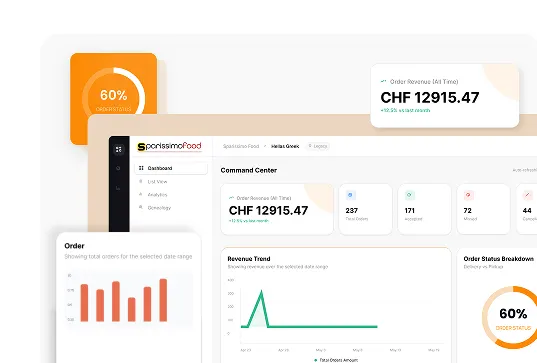
As your direct online ordering platform, SparissimoFood lets you set independent price tiers per channel from a single dashboard — update once, apply everywhere. It is designed to be the cheapest online option for your customers, positioned to win every price comparison against the apps.
SparissimoFood starts at CHF 49/month + 8% commission on direct orders — which, against Just Eat’s 25%+, means converting even a fraction of your delivery app traffic to direct orders produces a measurable return within the first month. It also supports TWINT natively, used in over 60% of Swiss digital payments.
Frequently Asked Questions
What is the ideal food cost percentage for a Swiss restaurant?
Between 27% and 32%. Swiss restaurants target the lower end of that range (27–30%) because labour costs represent 35–40% of revenue in Switzerland — significantly higher than the 28–32% seen in other European markets. Leaving food cost at 32–33% while paying Swiss wage levels typically results in an unprofitable operation.
Should restaurants charge more for delivery than dine-in?
Yes — and it is both standard industry practice and financially necessary. Charge 5–8% above the dine-in price for direct online orders (to cover packaging) and 15–20% above for third-party aggregators (to offset commissions). Without this adjustment, delivery orders in the Swiss market will consistently produce near-zero or negative net profit.
How often should a restaurant update its menu pricing?
At minimum twice per year — before the summer season and before the winter season. Any time a key ingredient cost changes by more than 15%, review that dish immediately. Given that Swiss food wholesale prices have risen 11.4% since 2022, this review cadence is more critical now than at any point in the past decade.
Is it legal in Switzerland to charge different prices on delivery apps vs. your own website?
Yes. Swiss consumer protection law does not require price parity across ordering channels. Restaurants are free to set different prices for dine-in, takeaway, direct online ordering, and third-party apps. Aggregator platforms permit this practice in their terms of service. It is standard practice among Swiss chain restaurants.
What is the most profitable direct online ordering platform for Swiss restaurants?
For independent Swiss restaurants, SparissimoFood is the most cost-effective direct ordering solution. At CHF 49/month + 8% on direct orders, it is significantly cheaper than routing orders through Just Eat or Uber Eats (25–30% commission). It includes native TWINT support and allows independent channel pricing from one dashboard — which is what makes tiered pricing operationally feasible for an independent operator.
The restaurants that will thrive in Switzerland over the next five years are not necessarily those with the best food. They are the ones with the best financial architecture — and menu pricing is where that architecture begins.
.Ds4FHhSq_ZxC9WE.webp "Restaurant Upselling Techniques That Don't Feel Pushy")

.CXCr6fQt_Z11gsYh.webp "Build a Branded Restaurant App Without Developers")
.y09Xtv8Z_1gH6f6.webp "Set Up Restaurant Online Ordering in Under a Week")
.B-Rl4IDw_Z204OoN.webp "Restaurant Loss Prevention and Theft Guide")
.DPpk5JZR_AlrVy.webp "Restaurant Communication During Peak Hours | Guide 2026")
.CRszlDy5_2neUXu.webp "How to Migrate from GloriaFood Without Disruption: A Technical Step-by-Step Guide")
.kT6N2QP-_1Tp2j1.webp "GloriaFood Is Shutting Down on April 30, 2027 — What Every Restaurant Owner Needs to Do Now")