
How to Reduce Restaurant No-Shows and Protect Your Revenue (2026)
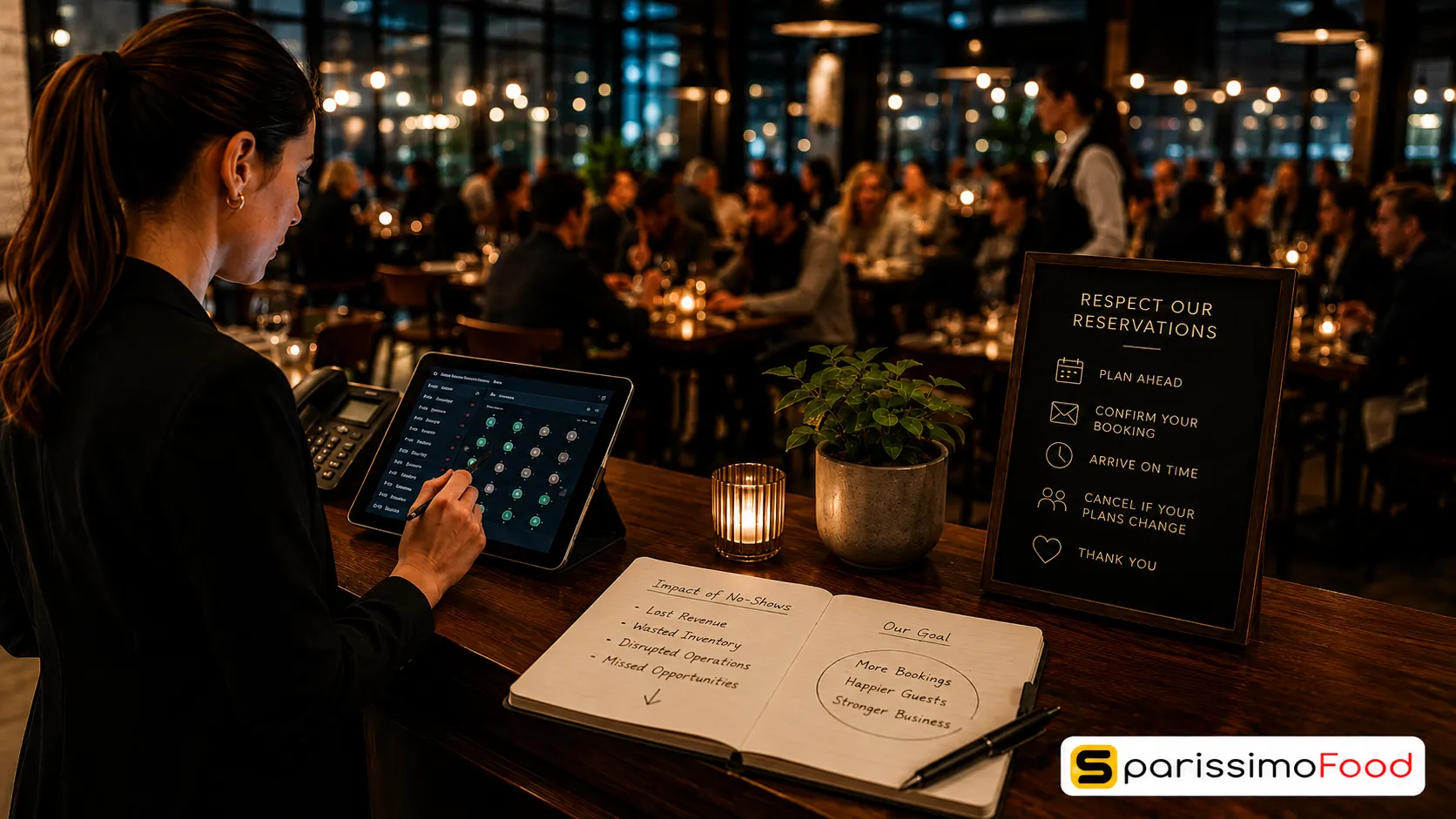

Quick Answer: Restaurant no-shows occur when guests make a reservation and fail to arrive without cancelling. The most effective methods to reduce them are: automated SMS reminders with one-tap cancellation links (sent 48 hours and 2 hours before), a clear written no-show policy displayed at booking, and credit card pre-authorisation for larger parties. For Swiss table-service restaurants, combining all three reduces no-show rates from an industry average of 15–20% down to 3–7%.
A table of four. Friday evening. Booked two weeks in advance. You turned away three walk-in parties to hold it.
They never arrived.
No call. No message. The table sat empty through your busiest service of the week, and there was nothing you could do about it.
If this sounds familiar, you are not alone. Restaurant no-shows are one of the most financially damaging — and most preventable — problems in the hospitality industry. This guide breaks down exactly what no-shows cost, why they happen, and the specific tactics that Swiss restaurant operators are using in 2026 to reduce them to near zero.
The Real Financial Cost of a Restaurant No-Show
Most restaurant owners think of no-shows as an inconvenience. The numbers tell a different story.
The calculation:
| Item | Value |
|---|---|
| Party size | 4 guests |
| Average spend per head | CHF 65 |
| Total order value | CHF 260 |
| Food cost (30%) | −CHF 78 |
| Labour (already scheduled) | −CHF 0 (sunk cost) |
| Lost Contribution Margin per No-Show | CHF 182 |
At just 3 no-show events per week, a Swiss restaurant loses approximately:
- CHF 546/week in contribution margin
- CHF 28,392/year — entirely preventable, entirely recoverable
And this calculation does not account for the walk-in guests you turned away to honour the reservation, or the psychological toll on your front-of-house team who prepared a table that was never used.
Why No-Shows Happen: The 3 Root Causes
Understanding why guests do not show up is essential before choosing the right prevention tactic. There are three distinct causes — and each requires a different solution.
Cause 1: They Simply Forgot
The most common cause by far. Life is busy. A reservation made two weeks ago disappears in the noise of daily schedules. The fix: automated reminders that bring the reservation back to the top of their mind.
Cause 2: Plans Changed But Cancelling Felt Difficult
Many guests intend to cancel but do not follow through because the cancellation process creates friction — they have to search for your phone number, call during working hours, and speak to someone. It feels like an effort, so they avoid it. The fix: make cancellation completely frictionless. A single link in a text message that cancels with one tap removes all friction.
Cause 3: They Never Genuinely Intended to Honour It
A small percentage of no-shows are from guests who booked speculatively — multiple restaurants on the same evening, intending to choose one. They had no real commitment. The fix: a financial stake in the reservation. Card pre-authorisation or a deposit means they only book if they actually plan to come.
Knowing which cause dominates your no-shows tells you where to focus first.
Tactic 1: The Automated SMS Reminder Sequence
This single tactic, implemented correctly, eliminates the majority of Cause 1 and Cause 2 no-shows.
The sequence:
Message 1 — 48 Hours Before:
“Hi [Name], this is a reminder of your reservation at [Restaurant] for [Number] guests on [Date] at [Time]. To confirm, reply YES. To cancel, tap here: [link]. We look forward to seeing you.”
Message 2 — 2 Hours Before:
“[Name], your table at [Restaurant] is ready for this evening at [Time]. If your plans have changed, cancel here: [link]. See you soon.”
Why two messages, not one? The 48-hour message catches the forgettors and gives cancellations time to come in — allowing you to offer the table to a waitlist. The 2-hour message catches last-minute changes and gives you enough time to seat a walk-in instead.
The one-tap cancellation link is non-negotiable. Without it, you are solving the reminder problem but not the friction problem. Guests who receive a reminder but cannot easily cancel will simply ignore it — and still not show up.
Industry result: Restaurants implementing a two-message SMS sequence with embedded cancellation links report a 40–60% reduction in no-show rates within the first 30 days.
Tactic 2: The Confirmation Reply Requirement
Take the SMS reminder one step further by requiring an active confirmation, not just offering one.
The message:
“Please reply YES to confirm your table at [Restaurant] on [Date] at [Time] for [Number] guests. If we don’t hear from you by [Deadline], your table may be released to our waitlist.”
This reframes the psychology of the interaction. Instead of “we will be here for you regardless,” the message communicates that the reservation requires their active participation. Guests who are genuinely coming will confirm. Guests who have forgotten or changed plans will either confirm properly or cancel — which is exactly what you want.
Set the confirmation deadline at 24 hours before the reservation. Any unconfirmed booking after that deadline can be offered to your waitlist, giving you a real fill opportunity rather than an empty table.
Tactic 3: Credit Card Pre-Authorisation (The Most Effective Deterrent)
For larger parties, peak evenings, set menus, and special events, card pre-authorisation is the single most effective no-show deterrent available.
How it works: At the time of booking, you collect the guest’s card details. A pre-authorisation hold of CHF 20–30 per person is placed on the card — meaning the funds are reserved but not charged. If the guest arrives as planned, the hold is released and nothing is charged. If they do not show and have not cancelled within your stated window, the hold converts to a charge.
The framing matters enormously. Always present this as a guest experience measure, not a penalty:
“To ensure we can prepare the perfect experience for your group and manage our kitchen accurately, we hold a CHF 20 per person deposit at booking. This is fully released on your arrival — we look forward to seeing you.”
This language is honest, warm, and presents the policy as something that benefits the guest. It avoids the defensive tone that can feel hostile and damage the relationship before the guest even walks in.
When to apply it:
- Groups of 6 or more — any size
- All bookings on Friday and Saturday evenings
- Special event nights (Valentine’s Day, New Year’s Eve, etc.)
- Fixed-price or tasting menu bookings at any size
Tactic 4: The Waitlist Strategy — Turning No-Shows into Last-Minute Covers
Even with the best prevention system, occasional no-shows will still occur. Having a waitlist transforms that empty table from a loss into a recovered cover.
How to run an effective waitlist:
- At the time of turning away a walk-in, take their name and phone number: “We’re fully booked tonight, but if anything opens up before 8pm I’ll text you immediately — can I take your number?” Most guests will say yes.
- When a cancellation or no-show occurs, immediately text the first person on the waitlist: “Hi [Name], a table for [Number] has just opened up at [Restaurant] tonight at [Time]. It’s yours if you can arrive within 20 minutes — reply YES.”
- Keep the offer time-pressured. A 20-minute window creates urgency without being unreasonable. If they do not respond, move to the next person on the list.
For restaurants in high-footfall locations — city centres, near theatres, or on busy pedestrian streets — a well-managed waitlist recovers 40–70% of cancelled or no-show tables during peak service windows.
Your Restaurant No-Show Policy: What to Include
Every restaurant that takes reservations needs a written no-show policy communicated clearly at the point of booking. Here is what it must cover:
1. The cancellation window: State exactly how many hours in advance a guest must cancel to avoid any charge. 24 hours is standard; 48 hours is reasonable for larger parties or special events.
2. The fee or charge (if applicable): If you use card pre-authorisation, state the amount clearly and when it will be charged. “A no-show fee of CHF 25 per person will be charged for bookings not cancelled at least 24 hours in advance.”
3. Where to cancel: Give them every easy option — a link in the confirmation SMS, a reply to the confirmation message, or a phone number. The easier you make it to cancel, the more cancellations you will actually receive.
4. Exceptions: Briefly acknowledge that genuine emergencies are handled case by case. This one line prevents the vast majority of disputes and preserves goodwill.
Where to display it: Booking confirmation SMS, email confirmation, and your reservation page. Not buried in a footer — front and centre, before the guest completes their booking.
How SparissimoFood Solves the No-Show Problem
Managing reservation reminders manually — writing individual texts, tracking confirmation replies, maintaining a phone waitlist — is operationally unrealistic for a busy restaurant team.
SparissimoFood’s pre-order and reservation system automates the entire sequence.
- Automated two-message SMS reminders fire at 48 hours and 2 hours before each reservation, with embedded cancellation links — no manual sending required
- Confirmation reply tracking automatically flags unconfirmed bookings and notifies your front-of-house team with enough time to release the table
- Integrated digital waitlist allows you to text the next guest on the list with one tap the moment a cancellation comes in
- Card pre-authorisation for selected booking types is configurable directly in your booking settings
The result is a no-show prevention system that runs in the background without adding to your team’s workload — so your staff can focus on the guests who do arrive.
SparissimoFood starts at CHF 49/month — and recovering even one no-show table per week pays for the platform multiple times over.
Frequently Asked Questions
What is a restaurant no-show?
A restaurant no-show occurs when a guest makes a reservation and fails to arrive at the appointed time without cancelling in advance. Industry data suggests 15–20% of all restaurant reservations result in a no-show, with the rate rising significantly on high-demand evenings like Fridays, Saturdays, and holidays.
How much do restaurant no-shows cost?
For a typical Swiss table-service restaurant, a single no-show for a table of four represents a lost contribution margin of approximately CHF 150–200 (total spend minus food cost). At three no-show events per week, this amounts to over CHF 28,000 in lost annual profit — entirely before accounting for walk-in guests turned away to hold those reservations.
Can Swiss restaurants legally charge a no-show fee?
Yes. Swiss restaurants are legally permitted to require card pre-authorisation and charge a no-show fee, provided the fee is clearly communicated to the guest at the time of booking. Transparency and explicit consent at the point of reservation are the key legal requirements. A clearly worded booking confirmation stating the fee amount and cancellation window is sufficient to make the charge enforceable.
What is the best way to reduce restaurant no-shows without charging a fee?
The most effective fee-free method is a two-message automated SMS reminder sequence with embedded one-tap cancellation links, sent 48 hours and 2 hours before the reservation. Restaurants implementing this sequence consistently see a 40–60% reduction in no-show rates without requiring any payment commitment from guests. Adding a digital waitlist to fill cancelled tables recovers much of the remaining loss.
How do I write a restaurant no-show policy?
A restaurant no-show policy should clearly state: (1) the cancellation window — how many hours before the reservation a guest must cancel, typically 24–48 hours; (2) the fee or charge that applies if they do not cancel within that window; (3) how to cancel easily; and (4) a brief note that genuine emergencies are handled case by case. This policy should appear in the booking confirmation message and on your reservations page — not in small print.
What is the no-show rate at most restaurants?
Industry benchmarks suggest the average restaurant no-show rate is between 15% and 20% of all reservations. This rate is significantly higher during holiday periods and for bookings made more than two weeks in advance. Restaurants that implement automated SMS reminders and card pre-authorisation for larger parties typically achieve no-show rates below 5%.
Every empty table in a restaurant represents two failures: a guest who did not arrive, and a system that did not prevent it. The tools to build that system exist today — and for most Swiss restaurants, implementing them takes less time than managing a single evening of no-shows.

.Ds4FHhSq_ZxC9WE.webp "Restaurant Upselling Techniques That Don't Feel Pushy")

.CXCr6fQt_Z11gsYh.webp "Build a Branded Restaurant App Without Developers")
.y09Xtv8Z_1gH6f6.webp "Set Up Restaurant Online Ordering in Under a Week")
.B-Rl4IDw_Z204OoN.webp "Restaurant Loss Prevention and Theft Guide")
.DPpk5JZR_AlrVy.webp "Restaurant Communication During Peak Hours | Guide 2026")
.B6eEizW1_Z2bHQYl.webp "Restaurant Menu Pricing Strategies That Actually Protect Your Margins in 2026")
.CRszlDy5_2neUXu.webp "How to Migrate from GloriaFood Without Disruption: A Technical Step-by-Step Guide")
.kT6N2QP-_1Tp2j1.webp "GloriaFood Is Shutting Down on April 30, 2027 — What Every Restaurant Owner Needs to Do Now")