
Commission vs Flat Fee Online Ordering: Real CHF Costs


Quick Answer: In commission vs flat fee online ordering, the cheaper model depends on your monthly online sales. At CHF 5,000 in direct online sales, a marketplace commission of 13% costs CHF 650, a hybrid plan of CHF 79 plus 5% costs CHF 329, and an illustrative flat fee of CHF 150 costs CHF 150. A flat fee wins on fees once sales pass the break-even point, which is the flat fee minus the plan fee, divided by the commission rate. Commission-based models cost less at low volume and can include discovery, logistics or tools that a bare flat fee does not.
A Swiss restaurant with 200 online orders a month at CHF 45 sells CHF 9,000 through its ordering channel. A marketplace at 28% commission takes CHF 2,520 of that. A flat fee of CHF 150 takes CHF 150. Both numbers are correct, and neither one tells you which model is right for your kitchen.
That is the real problem with commission vs flat fee online ordering. The two models charge for different things, so comparing the headline rate is misleading. This guide runs the same restaurant through every model in CHF, gives you the break-even formula, and covers the follow-up questions owners ask once the first number surprises them.
Commission vs Flat Fee Online Ordering: The Three Pricing Models
Most online ordering pricing falls into one of three structures. Knowing which one you are looking at is the first step, because vendors use different words for the same thing.
| Model | How you pay | Typical Swiss range | What usually comes with it |
|---|---|---|---|
| Marketplace commission | A percentage of every order, no monthly fee | 10–15% with your own drivers, 25–30% with the platform’s couriers, on Just Eat | Guest discovery through the app, optional courier delivery |
| Flat fee | One monthly subscription, 0% commission on orders | Varies widely by provider, this article uses CHF 150 and CHF 300 as illustrations | Your own ordering page and customer data, no discovery |
| Hybrid | A lower monthly fee plus a low commission | SparissimoFood: CHF 49 plus 8%, CHF 79 plus 5%, CHF 148 plus 5% | Your own ordering page, customer data, tools that grow with the plan |
Two notes keep the comparison fair. First, the flat fee figures in this guide are illustrations, not quotes from any provider. Check the current price of any vendor you shortlist. Second, payment processing applies to every model. Card and TWINT fees are charged per transaction whoever takes the order, so they are left out of the tables below and do not change the ranking.
Marketplace rates depend on who delivers, so our breakdown of what Just Eat charges Swiss restaurants is worth reading before you plug in your own contract rate. This guide uses 13% for own-driver orders and 28% for courier orders as typical midpoints.
What One CHF 45 Order Costs Under Each Model
Start with a single order, then scale up. Take a restaurant with 200 orders a month at CHF 45, or CHF 9,000 in sales. Monthly fees divided by 200 give the true cost per order.
| Model | Monthly cost on CHF 9,000 | Cost per CHF 45 order |
|---|---|---|
| Marketplace, own drivers, 13% | CHF 1,170 | CHF 5.85 |
| Marketplace, courier delivery, 28% | CHF 2,520 | CHF 12.60 |
| Hybrid Starter, CHF 49 plus 8% | CHF 769 | CHF 3.85 |
| Hybrid Business, CHF 79 plus 5% | CHF 529 | CHF 2.65 |
| Hybrid Professional, CHF 148 plus 5% | CHF 598 | CHF 2.99 |
| Flat fee, illustrative CHF 150 | CHF 150 | CHF 0.75 |
| Flat fee, illustrative CHF 300 | CHF 300 | CHF 1.50 |
Read the table honestly. On fees alone, a flat fee is the cheapest way to take 200 orders a month. The marketplace is the most expensive per order, but it is the only model that also finds you new guests. The hybrid models sit in between and are often the cheapest choice for restaurants below roughly 30 to 100 direct orders a month, as the next section shows.
Commission vs Flat Fee Online Ordering at Four Sales Levels
Volume decides the winner. Here are the monthly fees at four levels of online sales, using the same CHF 45 average order. The order counts are rounded.
| Monthly online sales | Marketplace 13% | Marketplace 28% | Hybrid Starter | Hybrid Business | Flat fee CHF 150 | Flat fee CHF 300 |
|---|---|---|---|---|---|---|
| CHF 2,000, about 44 orders | CHF 260 | CHF 560 | CHF 209 | CHF 179 | CHF 150 | CHF 300 |
| CHF 5,000, about 111 orders | CHF 650 | CHF 1,400 | CHF 449 | CHF 329 | CHF 150 | CHF 300 |
| CHF 9,000, about 200 orders | CHF 1,170 | CHF 2,520 | CHF 769 | CHF 529 | CHF 150 | CHF 300 |
| CHF 15,000, about 333 orders | CHF 1,950 | CHF 4,200 | CHF 1,249 | CHF 829 | CHF 150 | CHF 300 |
Three patterns stand out.
- Commission scales with sales, a flat fee does not. Every extra franc sold adds 5% to 28% to a commission bill. It adds nothing to a flat fee.
- The cheapest model changes at low volume. At CHF 2,000 in sales, a CHF 300 flat fee costs more than the CHF 179 Business plan.
- Marketplace commission is the highest at every level. That is not automatically a reason to leave. It is a reason to know what you are buying, which is covered further down.
The Break-Even Formula: When Does a Flat Fee Beat Commission?
You do not need to read the tables to settle commission vs flat fee online ordering for your own restaurant. One formula does it.
Break-even monthly sales = flat fee minus plan fee, divided by commission rate
Below that sales level the commission plan is cheaper. Above it the flat fee is cheaper. Divide the result by your average order value to get orders per month.
| Comparison | Break-even monthly sales | Break-even orders at CHF 45 |
|---|---|---|
| CHF 150 flat fee vs Starter, CHF 49 plus 8% | CHF 1,263 | about 28 |
| CHF 150 flat fee vs Business, CHF 79 plus 5% | CHF 1,420 | about 32 |
| CHF 300 flat fee vs Starter, CHF 49 plus 8% | CHF 3,138 | about 70 |
| CHF 300 flat fee vs Business, CHF 79 plus 5% | CHF 4,420 | about 98 |
The same logic works against a marketplace, with one change. Use the commission gap instead of the flat fee. Against a 13% marketplace rate, the Business plan breaks even at CHF 79 divided by 8 percentage points, which is about CHF 988 in sales, or 22 orders a month. Against a 28% courier rate the gap is 23 points and the break-even drops to about 8 orders.
Notice that the Professional plan never beats Business on fees, because both charge 5%. Choose Professional for what it includes, not for the price.
What the Sticker Price Leaves Out
A flat fee of CHF 150 and a hybrid fee of CHF 79 are not the same product. Before you compare totals, check these items on every quote. Our full guide to online ordering costs in Switzerland goes deeper on each one.
Payment processing. Card and TWINT fees apply on every model. Ask whether the vendor passes through the gateway rate or adds a markup.
Diner-paid fees. Some 0% commission platforms fund themselves with a small fee added at checkout. The restaurant pays no commission, but the guest sees a higher total. Ask what your guest will see.
Swiss payment and billing fit. Confirm that the platform supports TWINT, bills in CHF and handles MWST correctly. A vendor that bills in another currency adds exchange costs to the flat fee.
Delivery and hardware. Neither model delivers your food. Your own drivers or a courier service do that, and a tablet or printer for incoming orders is an extra cost on most plans.
MWST on the fees. Ask whether each fee is quoted before or after MWST. The Swiss Federal Tax Administration explains how MWST applies to your business, and it changes the franc figures in your own spreadsheet, not the ranking of the models.
Contract terms and data. Check the minimum term, the notice period and whether you can export your guest list. A low monthly fee matters less if you cannot leave with your customer data.
Which Model Fits Which Restaurant?
The right answer to commission vs flat fee online ordering follows your situation, not a universal rule.
A restaurant with fewer than about 30 direct orders a month. A hybrid plan usually costs least, because the low monthly fee outweighs the commission on small volume. This is also the safest way to test direct ordering.
An established restaurant with 100 or more direct orders a month. Run the break-even formula. At this volume a flat fee often costs less on fees alone. A hybrid plan can still be the better buy if it includes tools you would otherwise pay for separately, such as reports, a custom domain or a branded app.
A restaurant that relies on new guests. Keep a marketplace listing. Commission on an order you would not otherwise have received works like a customer acquisition cost. The problem starts when regulars order through the app every week and you pay 13% to 28% on guests who already know you.
A multi-location operator. Calculate each site separately. A dense city-centre site may pass a flat fee break-even in one week, while a quieter suburban site may not for months.
Can You Combine Models? What Owners Ask Next
Yes, and most profitable Swiss restaurants do. The marketplace brings discovery, and direct ordering keeps the margin on repeat guests. A simple sequence works:
- Keep the marketplace for new guests. Treat the commission as marketing spend.
- Give repeat guests a direct route. Put a QR code on packaging, add your ordering link to Google Business and offer a one-off voucher on the first direct order. Check your partner agreement first. Our guide to converting delivery app customers into direct orders has eight tactics that fit Swiss restaurants.
- Re-run the break-even each quarter. Direct volume grows, and the cheapest plan can change as it does.
If you are also weighing platforms by name, our comparison of low-commission ordering platforms covers how the options differ on TWINT, CHF billing and data ownership.
How SparissimoFood Helps With Choosing an Ordering Model
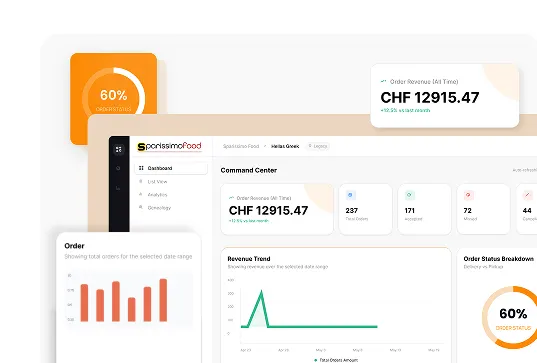
The break-even formula only works if you know your real direct volume. The SparissimoFood manager dashboard shows direct order counts, average order value and repeat guests in real time, so you can see the month you cross a break-even point instead of estimating it.
SparissimoFood is a hybrid model, which means it charges a commission. Starter costs CHF 49 a month plus 8% per order, Business costs CHF 79 a month plus 5%, and Professional costs CHF 148 a month plus 5%. The commission is lower than a marketplace rate, and the monthly fee is lower than many flat fee plans. The trade-off is the one in the tables above: at high direct volume, a flat fee can cost less on fees alone, so the formula is worth running for your own numbers.
Guest phone numbers and email addresses captured through direct orders belong to your restaurant. Details on all three plans and the 14-day free trial, which needs no credit card, are on the SparissimoFood plans page.
Frequently Asked Questions
Is a flat fee cheaper than commission for online ordering?
Above a certain volume, yes. The break-even monthly sales figure equals the flat fee minus the plan fee, divided by the commission rate. With an illustrative CHF 150 flat fee against a CHF 79 plan at 5%, the flat fee becomes cheaper above about CHF 1,420 in monthly sales, or 32 orders at CHF 45. Below that, the commission plan costs less.
What does commission-based online ordering cost a Swiss restaurant?
It depends on the model. Just Eat charges roughly 10–15% with your own drivers and 25–30% with its couriers. A hybrid plan such as SparissimoFood charges CHF 49 to CHF 148 a month plus 5–8% per order. On CHF 5,000 in monthly sales, that is CHF 650 at a 13% marketplace rate against CHF 329 on the Business plan.
Is 0% commission ordering really free of other fees?
No. Payment processing still applies on every model, and some platforms add a small fee that the guest pays at checkout. You should also check currency, TWINT support and any setup cost. Compare the total monthly cost, not only the commission rate.
Should I use both a marketplace and my own ordering page?
Usually yes. The marketplace finds new guests, and your own page earns more on repeat guests. A restaurant moving 20% of 400 monthly orders from a 13% marketplace to a CHF 79 plan at 5% saves about CHF 2,500 a year in fees. Keep both listings and re-run the break-even each quarter.
How do I decide commission vs flat fee online ordering for a new restaurant?
Start with the model that costs least at your expected volume. A new restaurant with under 30 direct orders a month usually pays less on a commission plan. Move to a flat fee only after the break-even formula shows it saves money, and confirm you can export your guest data if you switch.
A flat fee rewards the restaurant that already has the guests, and commission rewards the one still finding them.Commission vs Flat Fee Online Ordering: Which Model Saves a Swiss Restaurant More?
Quick Answer: In commission vs flat fee online ordering, the cheaper model depends on your monthly online sales. At CHF 5,000 in direct online sales, a marketplace commission of 13% costs CHF 650, a hybrid plan of CHF 79 plus 5% costs CHF 329, and an illustrative flat fee of CHF 150 costs CHF 150. A flat fee wins on fees once sales pass the break-even point, which is the flat fee minus the plan fee, divided by the commission rate. Commission-based models cost less at low volume and can include discovery, logistics or tools that a bare flat fee does not.
A Swiss restaurant with 200 online orders a month at CHF 45 sells CHF 9,000 through its ordering channel. A marketplace at 28% commission takes CHF 2,520 of that. A flat fee of CHF 150 takes CHF 150. Both numbers are correct, and neither one tells you which model is right for your kitchen.
That is the real problem with commission vs flat fee online ordering. The two models charge for different things, so comparing the headline rate is misleading. This guide runs the same restaurant through every model in CHF, gives you the break-even formula, and covers the follow-up questions owners ask once the first number surprises them.
Commission vs Flat Fee Online Ordering: The Three Pricing Models
Most online ordering pricing falls into one of three structures. Knowing which one you are looking at is the first step, because vendors use different words for the same thing.
| Model | How you pay | Typical Swiss range | What usually comes with it |
|---|---|---|---|
| Marketplace commission | A percentage of every order, no monthly fee | 10–15% with your own drivers, 25–30% with the platform’s couriers, on Just Eat | Guest discovery through the app, optional courier delivery |
| Flat fee | One monthly subscription, 0% commission on orders | Varies widely by provider, this article uses CHF 150 and CHF 300 as illustrations | Your own ordering page and customer data, no discovery |
| Hybrid | A lower monthly fee plus a low commission | SparissimoFood: CHF 49 plus 8%, CHF 79 plus 5%, CHF 148 plus 5% | Your own ordering page, customer data, tools that grow with the plan |
Two notes keep the comparison fair. First, the flat fee figures in this guide are illustrations, not quotes from any provider. Check the current price of any vendor you shortlist. Second, payment processing applies to every model. Card and TWINT fees are charged per transaction whoever takes the order, so they are left out of the tables below and do not change the ranking.
Marketplace rates depend on who delivers, so our breakdown of what Just Eat charges Swiss restaurants is worth reading before you plug in your own contract rate. This guide uses 13% for own-driver orders and 28% for courier orders as typical midpoints.
What One CHF 45 Order Costs Under Each Model
Start with a single order, then scale up. Take a restaurant with 200 orders a month at CHF 45, or CHF 9,000 in sales. Monthly fees divided by 200 give the true cost per order.
| Model | Monthly cost on CHF 9,000 | Cost per CHF 45 order |
|---|---|---|
| Marketplace, own drivers, 13% | CHF 1,170 | CHF 5.85 |
| Marketplace, courier delivery, 28% | CHF 2,520 | CHF 12.60 |
| Hybrid Starter, CHF 49 plus 8% | CHF 769 | CHF 3.85 |
| Hybrid Business, CHF 79 plus 5% | CHF 529 | CHF 2.65 |
| Hybrid Professional, CHF 148 plus 5% | CHF 598 | CHF 2.99 |
| Flat fee, illustrative CHF 150 | CHF 150 | CHF 0.75 |
| Flat fee, illustrative CHF 300 | CHF 300 | CHF 1.50 |
Read the table honestly. On fees alone, a flat fee is the cheapest way to take 200 orders a month. The marketplace is the most expensive per order, but it is the only model that also finds you new guests. The hybrid models sit in between and are often the cheapest choice for restaurants below roughly 30 to 100 direct orders a month, as the next section shows.
Commission vs Flat Fee Online Ordering at Four Sales Levels
Volume decides the winner. Here are the monthly fees at four levels of online sales, using the same CHF 45 average order. The order counts are rounded.
| Monthly online sales | Marketplace 13% | Marketplace 28% | Hybrid Starter | Hybrid Business | Flat fee CHF 150 | Flat fee CHF 300 |
|---|---|---|---|---|---|---|
| CHF 2,000, about 44 orders | CHF 260 | CHF 560 | CHF 209 | CHF 179 | CHF 150 | CHF 300 |
| CHF 5,000, about 111 orders | CHF 650 | CHF 1,400 | CHF 449 | CHF 329 | CHF 150 | CHF 300 |
| CHF 9,000, about 200 orders | CHF 1,170 | CHF 2,520 | CHF 769 | CHF 529 | CHF 150 | CHF 300 |
| CHF 15,000, about 333 orders | CHF 1,950 | CHF 4,200 | CHF 1,249 | CHF 829 | CHF 150 | CHF 300 |
Three patterns stand out.
- Commission scales with sales, a flat fee does not. Every extra franc sold adds 5% to 28% to a commission bill. It adds nothing to a flat fee.
- The cheapest model changes at low volume. At CHF 2,000 in sales, a CHF 300 flat fee costs more than the CHF 179 Business plan.
- Marketplace commission is the highest at every level. That is not automatically a reason to leave. It is a reason to know what you are buying, which is covered further down.
The Break-Even Formula: When Does a Flat Fee Beat Commission?
You do not need to read the tables to settle commission vs flat fee online ordering for your own restaurant. One formula does it.
Break-even monthly sales = flat fee minus plan fee, divided by commission rate
Below that sales level the commission plan is cheaper. Above it the flat fee is cheaper. Divide the result by your average order value to get orders per month.
| Comparison | Break-even monthly sales | Break-even orders at CHF 45 |
|---|---|---|
| CHF 150 flat fee vs Starter, CHF 49 plus 8% | CHF 1,263 | about 28 |
| CHF 150 flat fee vs Business, CHF 79 plus 5% | CHF 1,420 | about 32 |
| CHF 300 flat fee vs Starter, CHF 49 plus 8% | CHF 3,138 | about 70 |
| CHF 300 flat fee vs Business, CHF 79 plus 5% | CHF 4,420 | about 98 |
The same logic works against a marketplace, with one change. Use the commission gap instead of the flat fee. Against a 13% marketplace rate, the Business plan breaks even at CHF 79 divided by 8 percentage points, which is about CHF 988 in sales, or 22 orders a month. Against a 28% courier rate the gap is 23 points and the break-even drops to about 8 orders.
Notice that the Professional plan never beats Business on fees, because both charge 5%. Choose Professional for what it includes, not for the price.
What the Sticker Price Leaves Out
A flat fee of CHF 150 and a hybrid fee of CHF 79 are not the same product. Before you compare totals, check these items on every quote. Our full guide to online ordering costs in Switzerland goes deeper on each one.
Payment processing. Card and TWINT fees apply on every model. Ask whether the vendor passes through the gateway rate or adds a markup.
Diner-paid fees. Some 0% commission platforms fund themselves with a small fee added at checkout. The restaurant pays no commission, but the guest sees a higher total. Ask what your guest will see.
Swiss payment and billing fit. Confirm that the platform supports TWINT, bills in CHF and handles MWST correctly. A vendor that bills in another currency adds exchange costs to the flat fee.
Delivery and hardware. Neither model delivers your food. Your own drivers or a courier service do that, and a tablet or printer for incoming orders is an extra cost on most plans.
MWST on the fees. Ask whether each fee is quoted before or after MWST. The Swiss Federal Tax Administration explains how MWST applies to your business, and it changes the franc figures in your own spreadsheet, not the ranking of the models.
Contract terms and data. Check the minimum term, the notice period and whether you can export your guest list. A low monthly fee matters less if you cannot leave with your customer data.
Which Model Fits Which Restaurant?
The right answer to commission vs flat fee online ordering follows your situation, not a universal rule.
A restaurant with fewer than about 30 direct orders a month. A hybrid plan usually costs least, because the low monthly fee outweighs the commission on small volume. This is also the safest way to test direct ordering.
An established restaurant with 100 or more direct orders a month. Run the break-even formula. At this volume a flat fee often costs less on fees alone. A hybrid plan can still be the better buy if it includes tools you would otherwise pay for separately, such as reports, a custom domain or a branded app.
A restaurant that relies on new guests. Keep a marketplace listing. Commission on an order you would not otherwise have received works like a customer acquisition cost. The problem starts when regulars order through the app every week and you pay 13% to 28% on guests who already know you.
A multi-location operator. Calculate each site separately. A dense city-centre site may pass a flat fee break-even in one week, while a quieter suburban site may not for months.
Can You Combine Models? What Owners Ask Next
Yes, and most profitable Swiss restaurants do. The marketplace brings discovery, and direct ordering keeps the margin on repeat guests. A simple sequence works:
- Keep the marketplace for new guests. Treat the commission as marketing spend.
- Give repeat guests a direct route. Put a QR code on packaging, add your ordering link to Google Business and offer a one-off voucher on the first direct order. Check your partner agreement first. Our guide to converting delivery app customers into direct orders has eight tactics that fit Swiss restaurants.
- Re-run the break-even each quarter. Direct volume grows, and the cheapest plan can change as it does.
If you are also weighing platforms by name, our comparison of low-commission ordering platforms covers how the options differ on TWINT, CHF billing and data ownership.
How SparissimoFood Helps With Choosing an Ordering Model
The break-even formula only works if you know your real direct volume. The SparissimoFood manager dashboard shows direct order counts, average order value and repeat guests in real time, so you can see the month you cross a break-even point instead of estimating it.
SparissimoFood is a hybrid model, which means it charges a commission. Starter costs CHF 49 a month plus 8% per order, Business costs CHF 79 a month plus 5%, and Professional costs CHF 148 a month plus 5%. The commission is lower than a marketplace rate, and the monthly fee is lower than many flat fee plans. The trade-off is the one in the tables above: at high direct volume, a flat fee can cost less on fees alone, so the formula is worth running for your own numbers.
Guest phone numbers and email addresses captured through direct orders belong to your restaurant. Details on all three plans and the 14-day free trial, which needs no credit card, are on the SparissimoFood plans page.
Frequently Asked Questions
Is a flat fee cheaper than commission for online ordering?
Above a certain volume, yes. The break-even monthly sales figure equals the flat fee minus the plan fee, divided by the commission rate. With an illustrative CHF 150 flat fee against a CHF 79 plan at 5%, the flat fee becomes cheaper above about CHF 1,420 in monthly sales, or 32 orders at CHF 45. Below that, the commission plan costs less.
What does commission-based online ordering cost a Swiss restaurant?
It depends on the model. Just Eat charges roughly 10–15% with your own drivers and 25–30% with its couriers. A hybrid plan such as SparissimoFood charges CHF 49 to CHF 148 a month plus 5–8% per order. On CHF 5,000 in monthly sales, that is CHF 650 at a 13% marketplace rate against CHF 329 on the Business plan.
Is 0% commission ordering really free of other fees?
No. Payment processing still applies on every model, and some platforms add a small fee that the guest pays at checkout. You should also check currency, TWINT support and any setup cost. Compare the total monthly cost, not only the commission rate.
Should I use both a marketplace and my own ordering page?
Usually yes. The marketplace finds new guests, and your own page earns more on repeat guests. A restaurant moving 20% of 400 monthly orders from a 13% marketplace to a CHF 79 plan at 5% saves about CHF 2,500 a year in fees. Keep both listings and re-run the break-even each quarter.
How do I decide commission vs flat fee online ordering for a new restaurant?
Start with the model that costs least at your expected volume. A new restaurant with under 30 direct orders a month usually pays less on a commission plan. Move to a flat fee only after the break-even formula shows it saves money, and confirm you can export your guest data if you switch.
A flat fee rewards the restaurant that already has the guests, and commission rewards the one still finding them.




.Ds4FHhSq_ZxC9WE.webp "Restaurant Upselling Techniques That Don't Feel Pushy")






.CXCr6fQt_Z11gsYh.webp "Build a Branded Restaurant App Without Developers")
.y09Xtv8Z_1gH6f6.webp "Set Up Restaurant Online Ordering in Under a Week")
.B-Rl4IDw_Z204OoN.webp "Restaurant Loss Prevention and Theft Guide")


.DPpk5JZR_AlrVy.webp "Restaurant Communication During Peak Hours | Guide 2026")



.B6eEizW1_Z2bHQYl.webp "Restaurant Menu Pricing Strategies That Actually Protect Your Margins in 2026")
.CRszlDy5_2neUXu.webp "How to Migrate from GloriaFood Without Disruption: A Technical Step-by-Step Guide")
.kT6N2QP-_1Tp2j1.webp "GloriaFood Is Shutting Down on April 30, 2027 — What Every Restaurant Owner Needs to Do Now")